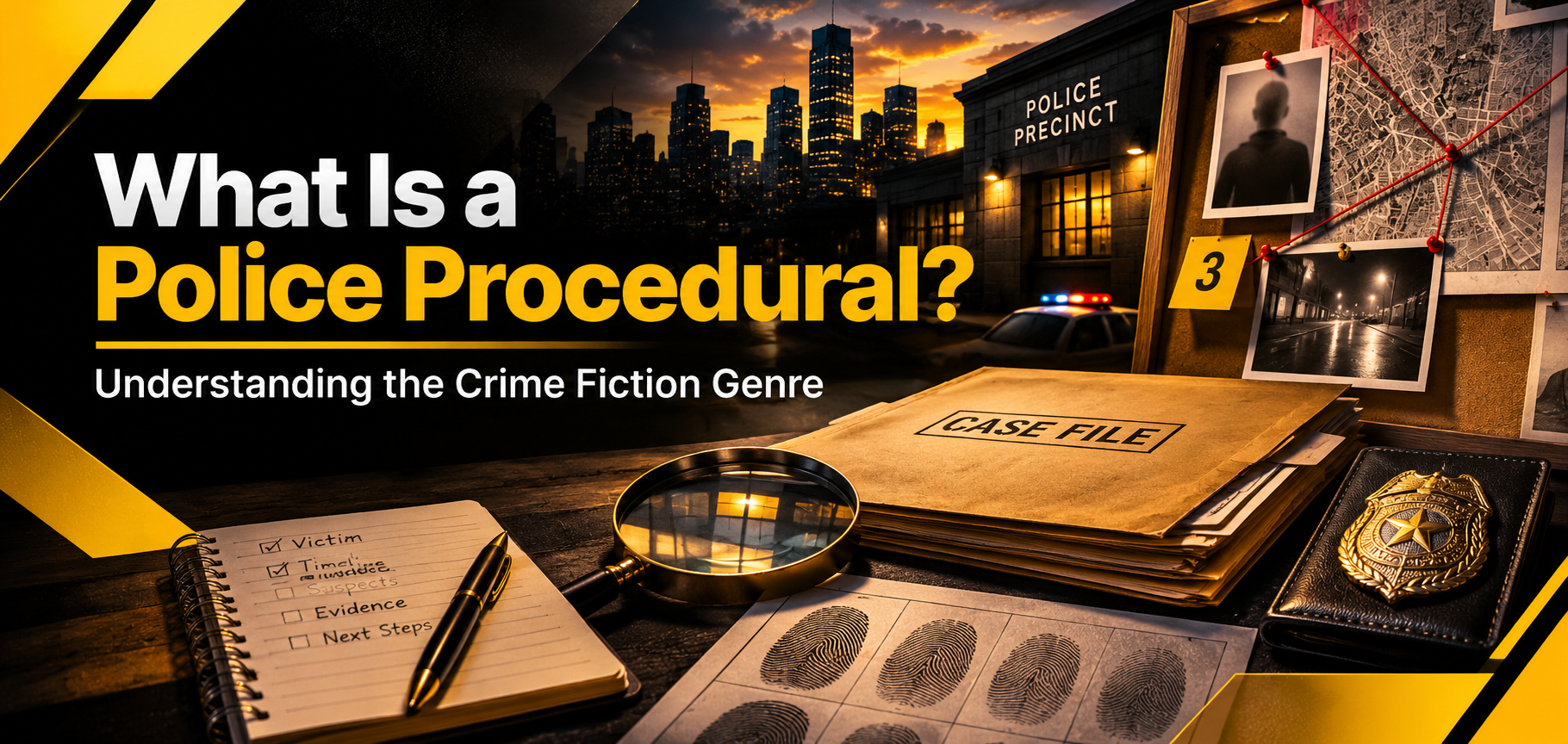
A detective finds a body, questions witnesses, studies evidence, follows leads, deals with supervisors, waits for lab results, writes reports, and slowly builds a case.
The mystery matters.
But so does the process used to solve it.
That focus on the work of policing is at the heart of the police procedural genre.
So, what is a police procedural?
A police procedural is a type of crime fiction that places significant attention on how police officers or investigators investigate crimes, gather evidence, interview people, follow procedures, work within a department, and move a case toward resolution.
The Cambridge Dictionary definition of police procedural describes it as a novel or drama centered on how police investigate and solve a crime.
That makes the genre different from a crime story that simply happens to feature a police officer.
In a true procedural, the investigative work itself is an important part of the story.
Police Procedural Meaning in Simple Terms
The easiest way to understand the police procedural meaning is to focus on the word “procedural.”
The story does not only ask:
Who committed the crime?
It also asks:
How will the police figure it out?
That can involve:
- Responding to a crime scene
- Securing evidence
- Interviewing witnesses
- Following leads
- Comparing statements
- Working with forensic specialists
- Requesting records
- Coordinating with other officers
- Dealing with supervisors
- Preparing reports
- Following legal procedures
- Revisiting theories when evidence changes
A police procedural may still contain suspense, action, personal conflict, corruption, romance, or psychological drama.
The defining feature is that police work and investigative process remain central to the story.
What Makes a Crime Story a Police Procedural?
Not every novel involving police is automatically a police procedural novel.
Several characteristics commonly separate procedural fiction from broader crime fiction.
1. The Investigation Is Central to the Plot
A procedural typically spends meaningful time showing how investigators move from:
crime to evidence to suspects to conclusions.
The audience sees the case develop.
Instead of skipping directly from the discovery of a body to the identification of a suspect, the story may explore the work between those moments.
That process can become the source of suspense.
A fingerprint may create a new lead.
A witness may contradict an earlier statement.
A report may reveal something investigators initially missed.
A routine interview may suddenly change the direction of the case.
The investigative process becomes part of the narrative rather than background decoration.
2. Police Methods Matter
Procedural fiction usually pays attention to the methods used by investigators.
That does not mean every novel must read like a training manual.
It means procedure has narrative importance.
For example, a story may show officers:
- Establishing control of a scene
- Documenting observations
- Preserving evidence
- Interviewing witnesses
- Coordinating responsibilities
- Reviewing records
- Following investigative leads
These details reflect real categories of investigative work.
The U.S. Department of Justice’s National Institute of Justice crime scene guidance describes real crime scene work as methodical and emphasizes protecting scenes, preserving evidence, documenting conditions, and collecting material for examination.
Fiction does not have to reproduce every real procedure exactly.
Still, those processes help explain why procedure-focused crime fiction can feel different from a mystery driven mainly by intuition or dramatic revelation.
3. The Investigator Usually Works Inside an Institution
Many traditional detective stories center on an unusually gifted individual.
Police procedurals often place the protagonist inside a larger organization.
That organization can include:
- Patrol officers
- Detectives
- Supervisors
- Crime scene personnel
- Forensic specialists
- Dispatchers
- Prosecutors
- Command staff
- Internal investigators
- Officers from other jurisdictions
The protagonist may be important, but the case rarely exists in isolation from the department.
That institutional setting creates another layer of storytelling.
An investigator may know what needs to be done but still have to deal with:
- Department rules
- Limited resources
- Chain of command
- Competing priorities
- Bureaucracy
- Internal politics
- Conflicting personalities
- Public pressure
The police department itself can become an important part of the fictional world.
4. Teamwork Often Matters More Than a Lone Genius
A classic fictional detective may solve a mystery almost entirely through personal brilliance.
A police procedural often distributes investigative work among several people.
One officer interviews witnesses.
Another processes evidence.
Another checks records.
A supervisor manages the investigation.
A forensic specialist examines physical evidence.
That structure reflects the fact that modern investigations can involve many different responsibilities.
The National Institute of Justice’s crime scene investigation resources describe tasks including documenting scenes, taking photographs and measurements, identifying physical evidence, collecting it, and maintaining chain of custody.
For a novelist, this creates opportunities for both realism and character conflict.
Different members of the team may interpret the same evidence differently.
5. Evidence Develops the Story
Evidence is often a major storytelling engine in police investigation novels.
That evidence might include:
- Fingerprints
- Video footage
- Phone records
- Documents
- Witness statements
- Physical objects
- Forensic findings
- Photographs
- Digital evidence
- Timelines
A good procedural does not simply introduce evidence because it sounds technical.
The evidence should change what investigators understand.
A new fact might eliminate one suspect.
Another might make an apparently reliable witness less credible.
A small inconsistency may send investigators back to the beginning.
This creates suspense through accumulation.
The reader learns the case piece by piece along with the investigators.
6. Interviews and Interrogations Can Drive the Plot
Police work is not only about physical evidence.
People matter too.
Procedural stories frequently use:
- Witness interviews
- Suspect interviews
- Conversations with victims
- Informants
- Family members
- Coworkers
- Other officers
The tension often comes from incomplete information.
A witness may remember only part of what happened.
Someone may be frightened.
Someone may deliberately lie.
Two truthful people may remember the same event differently.
That gives the writer room to build mystery without relying entirely on forensic evidence.
7. Reports, Records, and Routine Work Can Matter
One of the interesting things about the police procedural genre is that apparently ordinary work can become important.
The breakthrough does not always come from a dramatic chase.
It might come from:
- Reviewing an old report
- Checking a timestamp
- Comparing addresses
- Finding a missing document
- Reinterviewing a witness
- Connecting two incidents
- Noticing a contradiction
The procedural genre can make routine investigative work suspenseful because readers understand that small details may have larger consequences.
8. Police Culture Can Become Part of the Story
A police procedural does not have to focus exclusively on solving an external crime.
It can also examine the institution surrounding the investigators.
That may include:
- Loyalty between officers
- Leadership
- Training
- Department culture
- Pressure from supervisors
- Internal conflict
- Ethical decisions
- Discrimination
- Corruption
- Conflicts between duty and loyalty
This is one reason police-centered fiction can overlap with social drama, thriller fiction, and institutional fiction.
The investigation may provide the structure while conflicts inside the department provide another source of tension.
Police Procedural vs. Detective Fiction
The terms are related, but they are not always interchangeable.
A useful distinction is:
Detective fiction emphasizes the mystery and the person solving it.
Police procedural fiction places greater emphasis on the methods, systems, and institutional process used by police to investigate it.
Consider the difference this way:
| Element | Police Procedural | Traditional Detective Fiction |
| Central character | Often police officer or investigative team | Often detective, private investigator, amateur, or other sleuth |
| Main emphasis | Investigation process and police work | Solving the mystery |
| Institutional role | Often significant | May be limited |
| Teamwork | Common | Often more individual |
| Police hierarchy | Can affect the plot | Usually less central |
| Reports and procedure | Often visible | May be abbreviated |
| Forensics and evidence handling | Frequently important | Varies |
| Department politics | Can be major element | Usually secondary |
| Mystery | Important | Usually central |
These are tendencies, not strict rules.
Genre boundaries are flexible.
A novel can be both detective fiction and a police procedural.
Police Procedural vs. Crime Thriller
A crime thriller usually emphasizes urgency, danger, and escalating stakes.
The protagonist might be:
- A police officer
- Federal agent
- Journalist
- Attorney
- Civilian
- Former investigator
A police procedural can certainly be thrilling, but its identity comes more from the investigative framework.
A crime thriller may ask:
Can the protagonist stop the killer before the next attack?
A police procedural may spend more time asking:
What evidence will establish who the offender is, and how can investigators build the case?
Many modern books combine both.
Police Procedural vs. Mystery
Mystery is an extremely broad category.
The central appeal is usually an unanswered question.
Who committed the murder?
Why did someone disappear?
What really happened?
A police procedural can contain all those questions.
The difference is that the reader also spends meaningful time with the formal investigative process.
The mystery gives investigators a problem.
The procedural structure shows how they work through it.
Does a Police Procedural Have to Be Completely Realistic?
No.
Police procedural fiction is still fiction.
Writers may compress time, combine roles, simplify technical procedures, or increase dramatic tension.
Real investigations can involve extensive documentation, waiting, coordination, legal review, administrative tasks, and repetitive work.
A novel has to maintain narrative momentum.
The goal is often not perfect replication of real policing.
It is enough procedural credibility to make the fictional investigation feel believable within the world of the story.
What Makes a Police Procedural Feel Authentic?
Authenticity can come from many details besides technical jargon.
A believable procedural may show:
Consequences
Investigators’ decisions affect what happens next.
Limitations
Characters cannot obtain every answer instantly.
Teamwork
Different people contribute different information.
Documentation
Evidence and observations have to be recorded.
Conflicting Information
Witnesses and physical evidence do not always produce an obvious answer immediately.
Institutional Pressure
Investigators operate within a workplace, not a vacuum.
Human Judgment
Procedure cannot remove personality, bias, fear, ambition, loyalty, or uncertainty from an investigation.
These human pressures are often where the strongest police fiction develops.
What Does a Police Procedural Novel Usually Focus On?
A police procedural novel can focus on many different kinds of cases.
Examples include:
- Homicide
- Missing persons
- Organized crime
- Corruption
- Robbery
- Serial offenses
- Internal misconduct
- Cold cases
- Political crime
- Financial crime
The specific crime matters less to the genre definition than the way the investigation is presented.
If the reader spends significant time understanding how police approach the problem, the novel may have strong procedural elements.
Can Police Procedural Fiction Focus on Police Corruption?
Yes.
A procedural does not have to portray the police institution as unified or automatically trustworthy.
In fact, internal wrongdoing can create particularly complicated procedural stories.
The investigator may face two overlapping problems:
- Discovering what happened.
- Deciding whom inside the institution can be trusted.
That creates tension between:
- Loyalty and duty
- Career and conscience
- Department reputation and public responsibility
- Personal relationships and professional obligations
The institution that normally helps investigators solve the problem can become part of the problem itself.
Can the Police Institution Be as Important as the Crime?
Yes.
Some police-centered fiction uses individual cases to explore larger questions about policing.
The story may examine:
- How departments operate
- How officers are trained
- How workplace culture develops
- How authority affects people
- How institutional loyalty works
- How misconduct is handled
- How communities experience policing
At that point, the story becomes more than a simple whodunit.
The police institution itself becomes part of the subject.
Where A Broken Shield Fits Into Police-Centered Fiction
That institutional dimension creates a natural connection to A Broken Shield: Diaries From The Forsaken, Entry I.
According to Trapezoid Media’s description, A Broken Shield follows Julius Fernandez as he enters the Maryland State Troopers, progresses through police training, becomes a state trooper, and eventually confronts discrimination and conflict inside the department.
The novel’s central tension is therefore not simply built around an outside criminal investigation.
It is also about a police officer’s relationship with the institution he serves.
Julius is described as proud to wear the uniform and committed to protecting the community that raised him, but increasingly unable to ignore systemic discrimination inside the department.
That places the story in territory that can appeal to readers interested in police-centered fiction even when their interest extends beyond conventional case-solving.
Police Procedural Fiction Can Be a Hybrid Genre
A book does not have to fit inside one perfectly sealed genre category.
Police-centered stories frequently overlap with:
- Mystery
- Thriller
- Social drama
- Psychological fiction
- Political fiction
- Historical fiction
- Institutional drama
- Detective fiction
The Cambridge definition itself allows the police procedural form to appear in novels, films, and television, and procedural elements can coexist with other genre traditions.
That is useful for readers.
Instead of asking only:
“Is this book officially a police procedural?”
a more useful question may be:
“How important are police work, investigative process, and police institutions to the story?”
The stronger those elements become, the closer the story moves toward police procedural territory.
Why Are Police Procedural Books Popular?
Police procedural books give readers two experiences at once.
They provide a mystery or conflict to resolve, but they also show the machinery behind that resolution.
Readers get to see:
- How investigators think
- How evidence develops
- How witnesses affect cases
- How teams work
- How mistakes create consequences
- How institutions shape decisions
That creates a sense of progression.
Each interview, report, discovery, or contradiction can move the reader one step closer to understanding what happened.
The Appeal of Process
Many genres focus heavily on outcomes.
The police procedural makes the process itself interesting.
Readers may already suspect who committed a crime.
The suspense can still come from discovering whether investigators can:
- Prove it
- Find the right evidence
- Connect the right facts
- Overcome institutional obstacles
- Avoid mistakes
- Build a credible case
That makes procedural fiction especially effective for readers who enjoy problem solving.
The Appeal of Institutional Conflict
Another attraction is the opportunity to explore what happens inside a police organization.
A protagonist can face pressure from several directions at once.
The public wants answers.
Supervisors want results.
Partners expect loyalty.
Evidence points one way.
Personal conscience points another.
These competing pressures can make an internal departmental conflict every bit as dramatic as the external investigation.
The Appeal of Moral Questions
The best police-centered fiction often goes beyond a simple battle between good officers and bad criminals.
Characters may have to decide:
- What does loyalty actually require?
- What happens when following the group conflicts with doing what is right?
- Can an institution be changed from inside?
- What should an officer do after witnessing misconduct?
- What happens when professional identity clashes with personal values?
These questions can transform police crime fiction from a puzzle into a broader character study.
Common Characters in Police Procedural Fiction
Readers may encounter several recurring roles.
The Detective
Often responsible for developing the case and connecting evidence.
The Patrol Officer
May be the first person to encounter a crime, victim, witness, or suspect.
The Supervisor
Balances investigative needs with department responsibilities.
The Crime Scene Investigator
Documents and processes physical evidence.
The Forensic Specialist
Analyzes evidence that may help confirm or challenge an investigative theory.
The Partner
Provides another perspective and often creates the central working relationship.
The Prosecutor
Can influence how an investigation develops toward possible prosecution.
The Internal Investigator
Becomes particularly important when the alleged misconduct involves police officers themselves.
Not every procedural contains all these roles.
Their presence simply reflects the institutional nature of the genre.
What Should Readers Expect From Police Procedural Books?
Readers exploring police procedural books should generally expect more attention to investigative detail than they might find in a conventional action thriller.
That can mean:
- Slower evidence development
- Multiple interviews
- Competing theories
- Department relationships
- Procedural obstacles
- Legal limitations
- Team-based investigation
- Forensic details
- Ethical conflicts
The best books balance these elements with character and narrative momentum.
Procedure should deepen the story rather than overwhelm it.
Are Police Procedurals Only About Murder?
No.
Murder investigations are common because they create obvious stakes, but the genre can explore many kinds of wrongdoing.
A procedural could center on:
- Corruption
- Disappearance
- Fraud
- Organized crime
- Robbery
- Internal misconduct
- Political wrongdoing
- Cold cases
- Repeated criminal activity
What matters is the role of police investigation and procedure in the story.
Are All Police Novels Police Procedurals?
No.
A police officer can be the protagonist of:
- An action thriller
- Romance
- Historical novel
- Psychological drama
- Political thriller
- Horror story
- Social novel
without the book being primarily procedural.
The presence of a badge does not determine the genre.
The story’s focus does.
Quick Guide to Identifying a Police Procedural
When deciding whether a novel fits the genre, ask:
✔ Is a police officer or police team central to the story?
✔ Does the reader see how the investigation develops?
✔ Are evidence, interviews, records, or forensic work important?
✔ Does police procedure influence what characters can do?
✔ Does the department or chain of command matter?
✔ Do multiple investigators or specialists contribute?
✔ Does the story show the practical work between discovering a crime and resolving it?
✔ Would removing the police process fundamentally change the story?
The more often the answer is yes, the stronger the book’s procedural characteristics are likely to be.
Police Procedural Fiction Is About More Than Finding the Criminal
The simplest definition of a police procedural is a crime story that cares about how police reach the answer, not only what the answer turns out to be.
The genre can show readers:
- How evidence is developed
- How witnesses change an investigation
- How police teams function
- How procedures shape decisions
- How departments influence officers
- How institutional conflict complicates individual choices
That makes police procedural fiction particularly flexible.
It can function as a mystery, thriller, character study, or examination of the police institution itself.
For readers drawn to that final dimension, A Broken Shield: Diaries From The Forsaken, Entry I follows a young state trooper whose commitment to serving his community increasingly conflicts with what he witnesses inside his own department.
That kind of conflict shows why police-centered fiction can reach beyond the question of who committed a crime.
Sometimes the deeper question is what happens when the person wearing the badge begins questioning the institution behind it.
Frequently Asked Questions
What is a police procedural?
A police procedural is a type of crime fiction that focuses significantly on how police investigate and solve crimes. The investigative process, including evidence, interviews, teamwork, procedure, and departmental structures, is an important part of the story.
What is the difference between a police procedural and detective fiction?
Detective fiction generally emphasizes a mystery and the person solving it. Police procedural fiction puts more emphasis on police methods, teamwork, department structure, evidence handling, and the step-by-step investigative process. A book can contain elements of both.
What makes a novel a police procedural?
A novel usually has strong procedural characteristics when police investigators are central, the investigation is shown in meaningful detail, and police methods or institutional processes influence how the case develops.
Are police procedurals realistic?
They often aim for procedural credibility, but they remain fiction. Writers may simplify, combine, or compress real processes to maintain pacing and drama.
Do police procedural novels always focus on homicide?
No. They can involve missing persons, corruption, robbery, organized crime, internal misconduct, cold cases, fraud, and many other investigations.
Can a police procedural also be a thriller?
Yes. Police procedural and thriller elements frequently overlap. A story can show detailed investigative work while also using danger, urgency, and suspense associated with thrillers.
Can police corruption be part of a police procedural?
Yes. Corruption or misconduct inside a police organization can become a central investigative or institutional conflict. These stories often explore loyalty, ethics, authority, and accountability in addition to traditional crime solving.
What are police investigation novels?
Police investigation novels are crime stories centered on police officers or investigative teams solving cases. Some qualify strongly as police procedurals when they devote substantial attention to investigative methods and institutional processes.