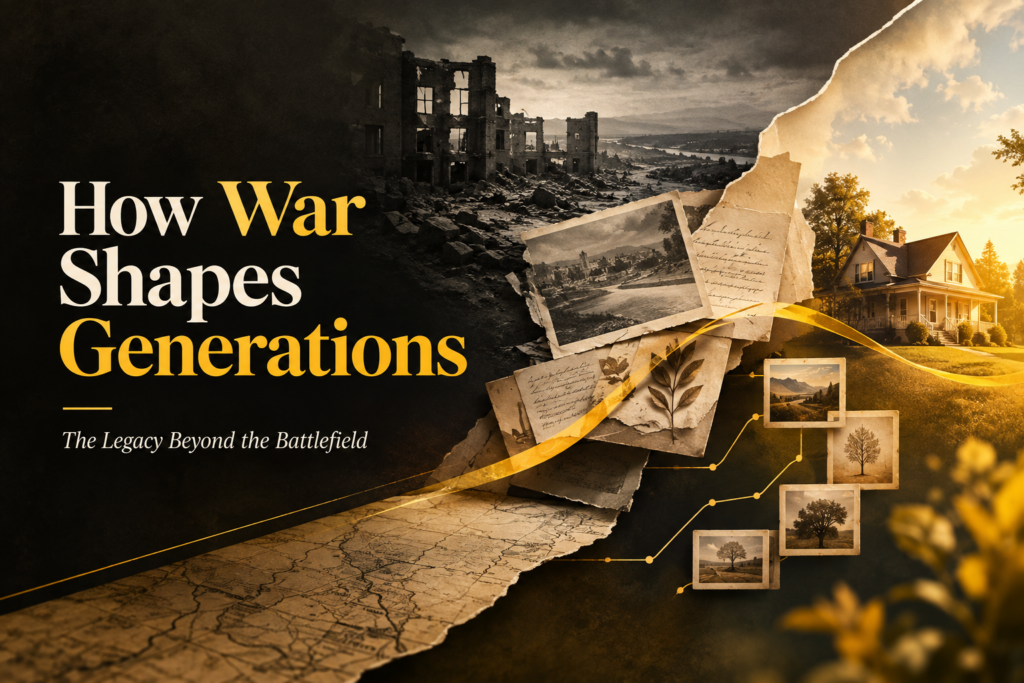
War can end on paper long before it ends inside a family.
The fighting may stop. Borders may change. Soldiers may return home. Governments may rebuild cities and declare a new beginning.
But what happens to the people who lived through it?
And what happens to the children who grew up hearing stories about it?
Sometimes the effects of war are visible in ruined buildings or abandoned homes. Other times, they appear years later in the way families communicate, the choices people make, the fears they carry, and the stories they pass to their children.
That is why understanding the effects of war on generations requires looking beyond the battlefield.
War can shape memories, relationships, communities, identities, and ideas about safety long after direct conflict has ended. Research on conflict-affected populations has found that the effects of war can extend across social and family systems, especially when displacement, loss, trauma, and disrupted communities are involved.
Key Takeaways
- War can influence families long after the original conflict ends.
- Children may inherit stories, fears, beliefs, and unresolved family experiences.
- Communities can experience lasting social and economic disruption.
- The generational impact of war is not only about trauma; it can also involve resilience, identity, memory, and rebuilding.
Why Does War Continue to Affect People After the Fighting Stops?
Imagine a family returning to the same neighborhood where they lived before a war.
The house may still be standing, but everything else feels different.
A parent remembers the nights spent hiding. A child remembers leaving home without understanding why. Years later, that child becomes a parent and tells their own children what happened.
The war is now three generations away from the people who first experienced it.
Yet the story remains.
This is one reason the generational impact of war can be difficult to measure. Not every consequence appears as a physical injury or a financial loss. Some effects are carried through memory, behavior, family stories, and social relationships.
The World Health Organization recognizes that emergencies and armed conflict can create serious mental health and psychosocial consequences while also emphasizing the importance of community and social support during recovery.
War changes the environment around people.
When that environment changes how families live, communicate, and think about the future, its influence can continue.
How War Affects Families Across Generations
Families are often where the consequences of war become most personal.
A family may experience death, separation, displacement, financial hardship, or the loss of a home. Even when those events happened decades earlier, they can continue influencing family relationships.
One generation may become highly protective of the next.
Another may avoid discussing the past.
Someone else may preserve every photograph, letter, or object connected to the conflict.
There is no single response.
This is important because how war affects families depends on many factors, including what happened during the conflict, whether the family was displaced, whether relatives were separated, what support became available afterward, and how the experience was remembered.
Some families become closer because shared hardship creates a powerful sense of responsibility.
Others struggle because pain was never discussed.
Still others transform difficult experiences into stories that help younger generations understand where they came from.
The Family Story Becomes Part of Identity
Children do not need to experience a war directly to grow up with an understanding of it.
They may hear phrases such as:
“We never waste food because we remember what happened.”
“Keep important documents safe.”
“Do not take security for granted.”
“We left everything behind once.”
Small statements can carry large histories.
Over time, these lessons become part of a family’s identity.
What Happens When Children Grow Up With War Memories?
A child growing up during or shortly after conflict may understand safety differently from someone who has never experienced major disruption.
For one child, an unexpected sound may mean nothing.
For another, it may bring back a family memory.
A parent who experienced displacement may place unusual importance on having a stable home.
A parent who experienced scarcity may teach their children to save everything.
A parent who lost relatives may speak constantly about family history.
These behaviors are not automatically signs of dysfunction. They can also be understandable attempts to make sense of a difficult past.
The problem comes when people inherit fear without also inheriting the opportunity to process the experience.
That can make the past feel permanently present.
The Social Effects of War Reach Beyond Individual Families
Families are only one part of the story.
War can reshape entire communities.
Schools may close or become difficult to access. Businesses can disappear. People can be displaced. Neighborhoods may change because residents leave and never return.
Some communities lose not only buildings but also institutions and traditions.
A local business that supported several generations may disappear.
A place of worship or community center may become inaccessible.
A neighborhood once filled with familiar families may become almost unrecognizable.
These are some of the social effects of war that can continue long after a peace agreement.
Rebuilding therefore involves more than repairing physical infrastructure.
Communities also need to restore trust, social connections, education, livelihoods, and a sense of continuity.
What Most People Forget About Social Recovery
People often imagine recovery as a straight line.
War ends.
Rebuilding starts.
Life returns to normal.
Real life is rarely that simple.
A city may rebuild its roads while families are still rebuilding their lives.
A school may reopen while children are still adjusting to displacement.
A family may return home while wondering whether it is safe to stay.
The physical recovery and emotional recovery do not necessarily happen at the same speed.
How War Changes the Way People Think About the Future
War can also alter a person’s relationship with uncertainty.
Someone who experienced sudden displacement may think differently about long-term plans.
A family that lost its income may become more financially cautious.
A person who watched institutions collapse may become skeptical of promises about stability.
This is where the relationship between war and future generations becomes especially interesting.
The next generation inherits not only the world rebuilt after conflict.
They may also inherit the worldview created by the conflict.
Children raised by people who lived through war can grow up hearing that stability is fragile.
That belief may influence where they live, what careers they choose, how they save money, or how strongly they prioritize family security.
But inheritance does not always mean repetition.
A child can receive a family’s history without repeating its fears.
That distinction is important.
Can War Also Create Resilience Across Generations?
Yes.
Focusing only on suffering can make the history of war feel incomplete.
Families and communities can also develop remarkable forms of resilience.
People rebuild homes.
They restore schools.
They preserve photographs and letters.
They document what happened.
They teach children about the past.
They create traditions that help younger generations remain connected to those who came before them.
Sometimes, a painful history becomes the reason a family values education, community, service, or peace more strongly.
This does not erase what happened.
It shows that the consequences of conflict are not always one-directional.
The long term effects of war can include both wounds and adaptations.
The same family story that begins with loss may eventually become a story about rebuilding.
Why Stories Matter When We Talk About War
Statistics can tell us how many people were displaced.
Historical records can tell us when battles occurred.
Photographs can show what destroyed neighborhoods looked like.
But personal stories can explain what those events felt like to the people living through them.
That is why books about war remain important.
A novel can follow a family across decades.
A character can show how one decision made during wartime changes another person’s life years later.
A story can explore something a historical timeline sometimes cannot: the emotional distance between what happened and what people remember.
This is particularly valuable when examining generations.
The central question becomes larger than:
“What happened during the war?”
It becomes:
“What happened to the people who survived it, and what did they carry forward?”
That question creates room for more complicated stories about memory, family, identity, responsibility, and survival.
What Makes War Stories Feel Personal Across Generations?
Consider a simple fictional family.
A grandfather experiences a war and spends the rest of his life avoiding the subject.
His daughter knows something happened but grows up without the full story.
Years later, she discovers old letters and begins asking questions.
Her own children suddenly learn that a quiet family habit they always considered normal began during a war they never experienced.
Nothing about their daily lives looks like a battlefield.
Yet the conflict has already shaped their family history.
This kind of scenario shows why how war changes society cannot be separated completely from how it changes individual lives.
Society is made of families, communities, institutions, memories, and relationships.
When those pieces change, people experience history personally.
How Do Societies Remember War?
Public memory can shape future generations just as family memory does.
Memorials, museums, books, documentaries, anniversaries, photographs, school lessons, and oral histories can influence how societies understand conflict.
Memory can preserve important truths.
It can also become contested.
Different groups may remember the same conflict differently. One generation may emphasize sacrifice. Another may focus on displacement. A later generation may ask questions that earlier generations were unwilling or unable to ask.
That is not necessarily a failure of memory.
It can be part of a society continuing to understand its own history.
The challenge is preserving complexity.
War stories should have room for civilians as well as soldiers, survivors as well as leaders, children as well as adults, and the years after conflict as well as the conflict itself.
What Most People Get Wrong About the Effects of War
Myth: War ends when the fighting stops.
Reality: Physical conflict may end while social disruption, displacement, grief, and family consequences continue.
Myth: Only people who directly experienced combat are affected.
Reality: Civilians, families, children, displaced communities, and later generations can also experience consequences.
Myth: Every family responds to war in the same way.
Reality: Families respond differently depending on their experiences, resources, relationships, and ability to rebuild.
Myth: Younger generations eventually forget.
Reality: Younger generations may know little about a conflict, or they may grow up deeply shaped by stories and memories passed down by relatives.
Myth: A war’s legacy is only negative.
Reality: War can leave profound harm while also producing forms of resilience, adaptation, community rebuilding, and renewed commitment to peace.
A Simple Framework for Understanding Generational Impact
When exploring the effects of war on generations, it helps to look at five connected layers:
1. Experience
What happened directly to the people who lived through the conflict?
2. Memory
What did they remember, record, avoid, or pass down?
3. Family
How did those experiences affect relationships, parenting, traditions, and expectations?
4. Community
How did neighborhoods, institutions, economies, and social connections change?
5. Future
What beliefs, stories, fears, values, and hopes reached later generations?
This framework also explains why two families living through the same war may emerge with very different stories.
History creates the event.
People create the legacy.
Why Books Can Help Us Understand Generational War
There is something powerful about experiencing history through a character.
A history book may explain a conflict.
A personal memoir may preserve firsthand memory.
A novel can do something different.
It can place the reader inside the uncertainty.
It can show how a war changes someone’s relationships.
It can follow one family beyond the final chapter of the conflict.
It can ask what happens when the person who experienced the war becomes a parent, then a grandparent, while carrying memories that the youngest family members only partly understand.
For readers interested in books about generations shaped by war, this perspective can make history feel less distant.
Instead of seeing war as a closed chapter, the reader begins to see it as an event with an extended human aftermath.
That is where historical fiction and war-centered storytelling can become especially meaningful.
Discover Stories That Follow War Beyond the Battlefield
For readers who want to explore these ideas through fiction rather than only through historical explanation, Trapezoid Media’s collection offers another way into the subject.
The author’s work centers on stories shaped by war and the experiences that continue after conflict. Rather than treating war as something that begins and ends with a battle, the books invite readers to consider the people, choices, relationships, and consequences that remain.
You can start by exploring the books and choosing the story that interests you most.
Readers who prefer to experience the author’s work in sequence can also use the reading order to see where to begin and how the books connect.
And for readers who want to understand the person behind the stories, the author’s about page provides a useful starting point for learning more about the perspective behind the work.
The appeal is not simply reading another story about war.
It is discovering what happens after the battlefield disappears from view.
That is where the effects of war become human.
Final Thoughts
The effects of war on generations cannot always be seen in ruins, photographs, or historical timelines.
Sometimes they appear in family habits.
Sometimes they live in stories told at the dinner table.
Sometimes they exist in the questions nobody asked for years.
And sometimes they appear in the next generation’s determination to build a different future.
War can reshape families, communities, identities, and expectations long after the conflict itself has ended. But its legacy is not only about what was lost. It is also about what people remember, what they rebuild, and what they choose to pass forward.
That is one reason stories about war remain relevant.
The battlefield may be the beginning of the story.
It does not have to be the end.
For readers who want to explore war through characters, families, and the consequences that continue beyond conflict, Trapezoid Media’s books offer a natural place to begin. The reading order can then help readers continue through the author’s work in sequence.
Sometimes the most powerful war stories are not about the moment everything changed.
They are about the generations that came afterward.
FAQs
What are the effects of war on generations?
The effects can include family disruption, displacement, grief, changed social relationships, economic hardship, inherited memories, and long-lasting changes in how later generations understand safety and identity.
What is the generational impact of war?
The generational impact describes how experiences of conflict can influence children and later generations through family relationships, memories, behavior, beliefs, community changes, and social conditions.
How does war affect families?
War can separate families, cause loss and displacement, disrupt livelihoods, and influence parenting, relationships, family traditions, and the way history is remembered.
What are the social effects of war?
Social effects can include displacement, weakened communities, disrupted education, loss of institutions, economic disruption, changes in population, and difficulties rebuilding trust.
Can war affect people who were born after the conflict?
Yes. Later generations may be influenced by family stories, inherited beliefs, community conditions, unresolved historical issues, and the social environment created by the conflict.
What are the long term effects of war?
Long-term effects can include ongoing social disruption, displacement, economic challenges, family consequences, psychological distress, changes in community life, and lasting memories of conflict.
How does war change society?
War can change population patterns, institutions, family structures, economic systems, community relationships, cultural memory, and the way people think about safety and the future.
Can war create resilience across generations?
Yes. Families and communities may respond to hardship by preserving history, rebuilding institutions, strengthening relationships, and developing values centered on survival, community, and peace.
Why are books about war important?
Books can explore the human side of conflict, including memory, family relationships, identity, loss, resilience, and the experiences that continue after a war ends.