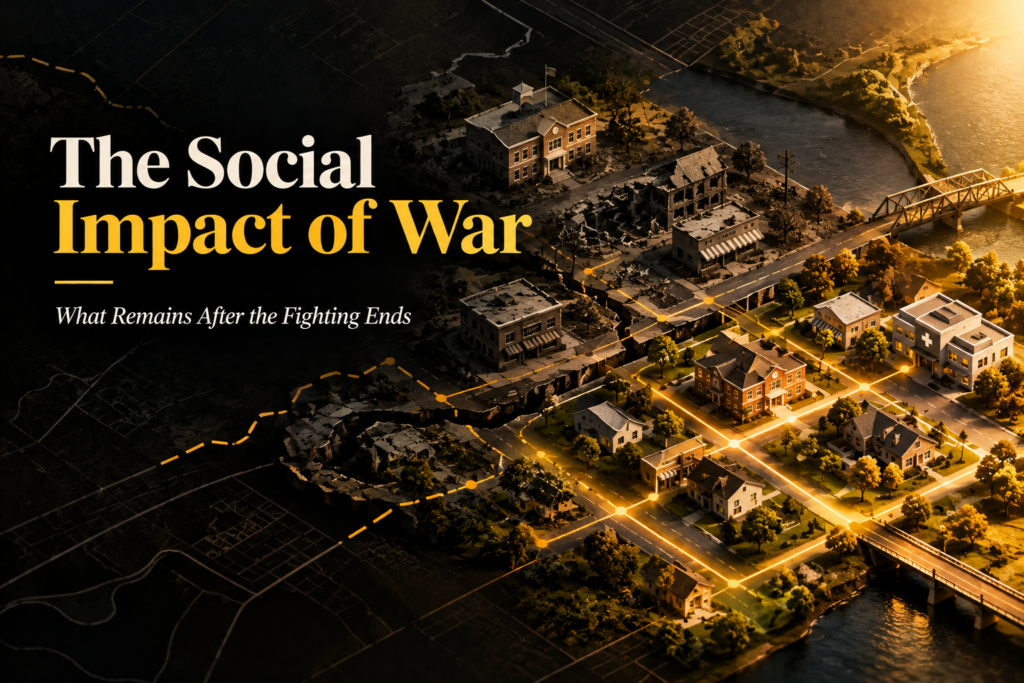
A war can destroy a building in seconds.
Rebuilding it can take years.
But what about rebuilding the community that lived inside it?
When people talk about war, the conversation often turns toward battles, military strategy, political decisions, and casualty figures. Those things matter. Yet some of the deepest consequences appear in places that are harder to photograph.
A school closes.
A family leaves.
A neighborhood loses its older generation.
A business disappears.
Children grow up somewhere else.
Years later, the roads may be repaired, but the community is no longer quite the same.
That is the deeper social impact of war.
War changes more than territory. It can reshape families, education, work, migration, trust, identity, and the way communities imagine their future.
Key Takeaways
- War can disrupt the social systems that hold communities together.
- Displacement can change neighborhoods long after fighting ends.
- Education, employment, healthcare, and local institutions may take years to recover.
- The effects of war can continue through memory, family relationships, and future generations.
- Recovery involves rebuilding trust and community life, not just physical infrastructure.
What Happens to a Community When War Begins?
Imagine a neighborhood where everyone knows everyone.
There is a school nearby.
Local shops support families.
Older residents remember how the neighborhood looked decades earlier.
Children walk the same streets their parents once walked.
Then a conflict begins.
Some people leave immediately.
Others stay because they have nowhere else to go.
Businesses close. Schools stop operating normally. Families become separated. Familiar places disappear.
The community starts losing the ordinary routines that made it feel like a community.
This is one of the most important parts of understanding the effects of war on society.
War does not only destroy individual lives.
It can interrupt the relationships and institutions connecting those lives.
The World Health Organization notes that armed conflict and other emergencies can disrupt families, livelihoods, essential services, safety, and social networks.
Once those connections are weakened, rebuilding becomes much harder.
How War Disrupts Families
The family is often the first social structure affected by conflict.
People may be separated by evacuation, migration, military service, displacement, or loss.
A parent may leave with one child while another relative remains behind.
Grandparents may become primary caregivers.
Older children may take on responsibilities that normally belong to adults.
Even after families reunite, they may not return to the same routines.
Someone may have spent years living somewhere else.
Another person may have become financially responsible for the household.
Children may have grown up during years of uncertainty.
These changes help explain the social consequences of war.
The damage is not always visible.
A family can live in the same house after a conflict and still be living with a completely different family structure.
What Happens When People Are Forced to Leave?
Displacement is one of the clearest examples of the community impact of war.
When people leave their homes, they do not take only their belongings.
They leave behind workplaces, schools, neighbors, familiar streets, community traditions, and social networks.
The people receiving displaced families can also experience major changes.
New schools need to accommodate more children.
Housing becomes more difficult to secure.
Local healthcare systems face additional pressure.
Jobs become harder to find.
Neighborhoods change rapidly.
The World Health Organization reports that forced displacement can affect access to housing, healthcare, social protection, livelihoods, and other essential services, while discrimination and loss of family support can increase vulnerability.
This is why displacement should not be viewed as simply a movement from one location to another.
It is often a complete social reset.
How War Changes Education
A school is more than a building.
It is a meeting point.
It gives children routine, teachers a role, families a support structure, and communities a sense of continuity.
When conflict damages schools or makes them unsafe, the consequences can spread far beyond education.
Students lose learning opportunities.
Teachers may leave.
Families may relocate.
Children may be forced into work or caregiving responsibilities.
WHO documentation on conflict and migration describes how violence, damaged infrastructure, displacement, poverty, and security concerns can all interfere with education access.
The effects can last even after schools reopen.
A child who missed years of education may return with gaps that are difficult to close.
A teacher who left may never return.
A community may have an entire age group whose education looks different from the generation before it.
That is how war creates consequences that continue long after the initial destruction.
Why Jobs and Local Economies Matter So Much
People often think of rebuilding as construction.
But a rebuilt city without functioning livelihoods is not a fully rebuilt community.
Small businesses may have closed during the conflict.
Factories may have stopped operating.
Farmers may have lost access to land.
Workers may have relocated.
Customers may no longer live nearby.
Even when buildings return, the economic relationships that once made the local economy work may have changed.
This is another major part of war and social change.
When work disappears, people move.
When people move, businesses lose customers.
When businesses disappear, local tax bases shrink.
When local resources shrink, schools and public services can struggle.
One disruption can create another.
That is why post-conflict recovery often requires rebuilding economic opportunity alongside physical infrastructure.
What Happens to Healthcare and Essential Services?
A functioning community depends on systems that most people barely notice until they stop working.
Hospitals.
Clinics.
Water systems.
Transport.
Schools.
Emergency services.
Food distribution.
Waste collection.
Conflict can damage or interrupt these systems.
The current humanitarian situation in Sudan provides a stark example of how prolonged conflict can cripple healthcare systems, disrupt basic services, and leave communities facing overlapping health and social pressures.
But the broader lesson is not limited to one conflict.
When essential systems weaken, people often have to solve problems individually that were once handled collectively.
Families search for healthcare.
Parents find alternative schools.
Communities organize informal support.
Local organizations fill gaps.
Sometimes those efforts build new forms of solidarity.
Sometimes they reveal just how much a community depended on institutions that disappeared.
How Does War Affect Trust?
Trust is one of the least visible casualties of conflict.
People may begin to distrust institutions.
Neighbors may become suspicious of one another.
Communities may fracture along political, ethnic, religious, or social lines.
Even after violence decreases, those divisions can remain.
That is why peace is not simply the absence of shooting.
It can also require rebuilding confidence between people who have learned to see one another as threats.
The United Nations describes post-conflict peacebuilding as a process that can involve rebuilding institutions, strengthening social cohesion, supporting reintegration, and addressing local tensions after major violence declines.
A road can be rebuilt with concrete.
Trust cannot.
It has to be rebuilt through repeated interactions.
What Does War Do to Community Identity?
Every community has a story.
Maybe it is a neighborhood known for its markets.
Maybe it is a village connected by generations of farming.
Maybe it is a city whose identity comes from its architecture, schools, music, or local traditions.
War can interrupt that story.
People move away.
Buildings disappear.
Traditional gathering places close.
Languages or customs may become less visible as populations change.
Yet identity can also become stronger under pressure.
Communities may preserve old songs, recipes, photographs, ceremonies, or oral histories because they fear losing another piece of the past.
This creates an important tension.
War can damage community identity.
It can also make people more determined to protect it.
Why Children Often Carry the Effects Forward
A child may not understand political decisions.
They understand that someone disappeared.
They understand that school stopped.
They understand that the family moved.
They understand that home no longer feels the same.
These experiences can shape how children understand safety, community, authority, and the future.
Some become more cautious.
Some become more independent.
Some become determined to build something better.
Some may spend years trying to understand what happened.
This is why the war beyond the battlefield matters so much.
Children experience war through ordinary life.
A classroom can become a shelter.
A family dinner can become a discussion about whether it is safe to go outside.
A move to another country can become the dividing line between childhood and adulthood.
Years later, those memories may remain part of how a person understands home.
What Happens When Refugees Return?
Returning home sounds simple until someone actually tries to do it.
A family may return to discover that the house is damaged.
The old school may be gone.
The neighborhood may have a different population.
Former employers may no longer exist.
Friends may have settled somewhere else.
Land ownership may be disputed.
The place may technically be home, but the social world that made it home has changed.
This is why the community impact of war can continue after people return.
Return does not always restore the past.
Sometimes it creates a new community made up of people who stayed, people who left, and people who arrived later.
That mixture can produce tension.
It can also create new relationships.
Can Communities Rebuild After War?
Yes, but rebuilding is rarely immediate.
Recovery often begins with practical needs.
Safe housing.
Schools.
Healthcare.
Jobs.
Transportation.
Then come the less visible needs.
Trust.
Belonging.
Shared identity.
Memory.
Participation.
The United Nations has documented examples where local reconciliation efforts, youth-led mediation, and community economic initiatives have helped strengthen social cohesion during prolonged conflict.
That illustrates an important point.
Communities do not rebuild only because governments announce recovery plans.
They rebuild because people start reconnecting with one another.
A market opens.
A school welcomes children again.
Neighbors work together.
Young people participate in local decisions.
Families begin planning for next year instead of next week.
Those small changes can become the foundation for a new social order.
What Most People Get Wrong About the Effects of War
Myth: War ends when the fighting stops.
Reality: Social disruption, displacement, damaged services, and weakened trust can continue after active fighting declines.
Myth: Rebuilding means repairing buildings.
Reality: Communities also need functioning schools, healthcare, livelihoods, social networks, institutions, and trust.
Myth: Everyone who returns home returns to the same community.
Reality: Population movement can permanently change neighborhoods, economies, institutions, and social relationships.
Myth: Children simply forget what happened.
Reality: Childhood experiences can influence how later generations understand safety, family, identity, and community.
Myth: The social effects are always negative.
Reality: Conflict causes profound damage, but communities can also develop resilience, new forms of cooperation, and stronger commitments to rebuilding.
A Five-Part Framework for Understanding War’s Social Impact
When exploring the social impact of war, it helps to look beyond the immediate violence.
1. People
Who leaves, who stays, and who is lost?
2. Places
What happens to homes, schools, businesses, and community spaces?
3. Systems
What happens to education, healthcare, employment, and public services?
4. Relationships
How are family ties, friendships, trust, and community connections affected?
5. Memory
What do later generations remember, inherit, preserve, or question?
This framework explains why war can remain socially important long after the visible conflict ends.
A destroyed building can be reconstructed relatively quickly.
A damaged social network may take decades to rebuild.
Why War Stories Help Us Understand Communities
There is a reason people continue reading books about war long after the wars themselves become history.
Facts can tell us what happened.
Stories can show us what happened to people.
A novel can follow one family through displacement.
It can show a neighborhood changing slowly.
It can place a character between loyalty to home and the need to leave.
It can show what happens when someone returns and discovers that home is no longer the place they remember.
This is where literary storytelling becomes especially useful.
A reader does not simply learn about a conflict.
They experience the uncertainty surrounding it.
They see how political events enter kitchens, schools, friendships, and families.
That can make the social consequences of war easier to understand because they stop being abstract.
They become personal.
War Beyond the Battlefield: The Stories People Carry
The most lasting image of war is often not the battlefield.
It may be the empty chair at the family table.
The closed school gate.
The shop that never reopened.
The photograph kept inside a drawer.
The child asking why the family moved.
The grandparent telling a story that happened before the child was born.
Those moments reveal how war changes society from the inside.
The consequences are stored in routines.
In relationships.
In memories.
In places.
In people.
And eventually, in the generations that come afterward.
Explore War Through Stories and Different Human Perspectives
For readers who want to go beyond historical summaries and explore how conflict affects individual lives and communities, literature can offer a different perspective.
The author’s books provide an opportunity to explore war through characters, personal experiences, relationships, and the consequences that continue beyond the battlefield.
Readers who want to understand how the author’s stories fit together can follow the reading order and experience the work in sequence.
And for readers who want more context about the writer and the ideas behind the stories, the author’s about page offers a natural place to begin.
The value of these stories is not simply that they are about war.
It is that they ask what war does to people when the headlines move on.
What happens to the family?
What happens to the neighborhood?
What happens to the person who comes home?
And what happens to the generation that grows up afterward?
Those questions can stay with a reader long after the story ends.
Final Thoughts
The social impact of war is easy to underestimate because it does not always look like destruction.
Sometimes it looks like migration.
Sometimes it looks like a school that stays closed.
Sometimes it looks like a family trying to rebuild its finances.
Sometimes it looks like neighbors who no longer trust one another.
Sometimes it looks like a child growing up with stories about a place they barely remember.
Those are all forms of history.
And they explain why the effects of war on society can continue for years after the visible fighting stops.
A war can destroy homes, but it can also disrupt the relationships that made those homes part of a community.
A conflict can close schools, but its effect may continue through the education children missed.
It can force people to leave, but the social consequences can remain in both the community they left and the community that received them.
It can damage trust, and rebuilding that trust can be much harder than repairing a road.
Yet communities are not passive.
People rebuild.
They reconnect.
They preserve stories.
They reopen schools.
They create new businesses.
They remember what was lost while making space for what comes next.
That is why understanding war beyond the battlefield matters.
The real aftermath is not only found in damaged buildings or historical archives.
It is found in people.
Because the most important question after a war may not be:
“When did the fighting end?”
It may be:
“What kind of community was left behind, and what did its people become?”
FAQs
What is the social impact of war?
The social impact of war includes changes to families, communities, education, employment, healthcare, migration, trust, identity, and social relationships.
What are the effects of war on society?
War can disrupt essential services, separate families, displace populations, weaken institutions, damage livelihoods, and change how communities relate to one another.
What is war and social change?
War and social change describes how prolonged conflict can transform population patterns, institutions, family structures, economies, identities, and community relationships.
What are the social consequences of war?
Social consequences can include displacement, family separation, disrupted education, loss of livelihoods, weakened social networks, damaged institutions, and reduced trust.
How does war affect communities?
War can disrupt homes, schools, businesses, healthcare, transportation, social networks, and local institutions, making everyday community life difficult.
Can war affect communities after fighting ends?
Yes. Rebuilding schools, services, livelihoods, trust, and social connections can continue long after active conflict decreases.
How does displacement change communities?
Large-scale displacement can alter housing, schools, labor markets, healthcare needs, population patterns, and relationships between displaced and host communities.
How can war affect future generations?
Children can inherit family memories, changed social conditions, economic consequences, and beliefs shaped by conflict, even when they did not experience the fighting directly.
Can communities become stronger after war?
Yes. Communities may develop new forms of cooperation, reconciliation, local leadership, and resilience while rebuilding.
Why read books about the social impact of war?
Stories can help readers understand how large historical events affect families, communities, identities, relationships, and everyday life in ways statistics alone may not show.