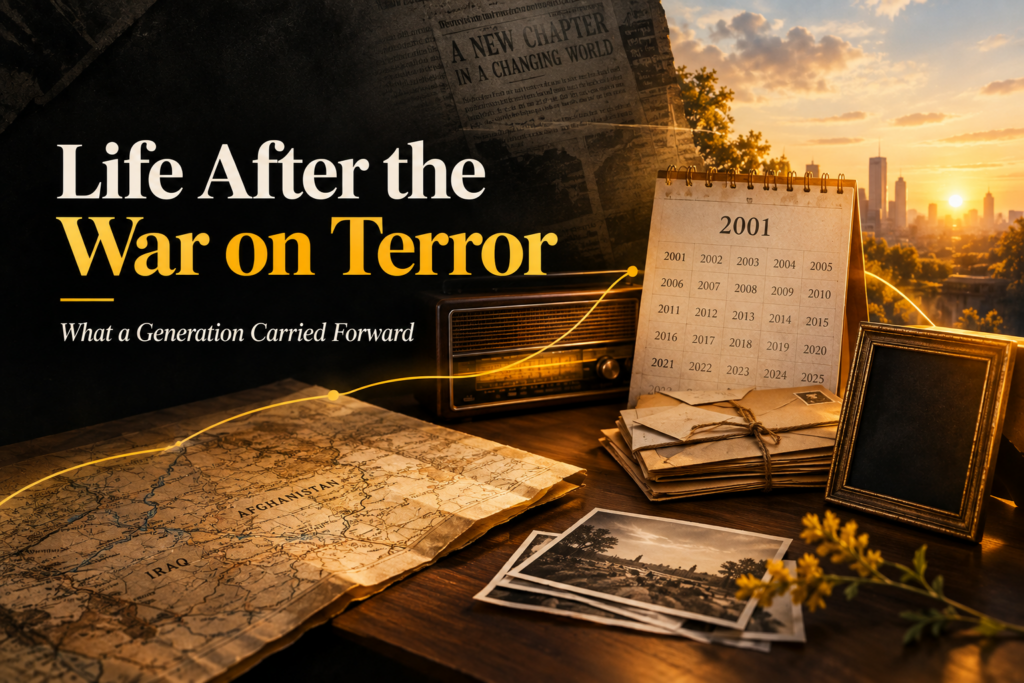
For some people, war is something they remember.
For others, it is something they grew up with.
A child who watched the news after September 11, 2001, eventually became a teenager while wars in Afghanistan and Iraq were still unfolding. That teenager later became an adult while deployments, terrorism alerts, military debates, and arguments about national security remained part of public life.
The conflict changed over time.
The generation did too.
That raises a question that is easy to overlook: What does life after the global war on terror look like for the people who came of age during it?
The answer is not only found in military timelines or changes in foreign policy. It can also be found in families, friendships, memories, identity, social expectations, and the ways people understand safety and uncertainty.
For a generation that lived through years of conflict while becoming adults, the war was not always a distant event.
It was part of the background of growing up.
Key Takeaways
- The War on Terror influenced a generation through both direct and indirect experiences.
- Its consequences can continue through families, communities, memory, and social attitudes.
- Millennials came of age during a prolonged period of war and national-security uncertainty.
- Life after conflict is often less about a clean ending and more about learning what to do with what remains.
What Did the War on Terror Mean to the Generation That Grew Up During It?
Think about what it means to grow up without a clear sense of when the “war years” began or ended.
For many Millennials, the events of 9/11 happened during childhood, adolescence, or early adulthood.
The aftermath became part of ordinary life.
News coverage focused on Afghanistan and Iraq. Military deployments became familiar. National-security language became part of everyday political conversation. Questions about terrorism, surveillance, patriotism, and military intervention appeared repeatedly in public life.
Not everyone experienced these events in the same way.
Some people had family members in uniform.
Some lived in military communities.
Some experienced the wars through relatives who returned home carrying difficult memories.
Others had no direct family connection to the military but still grew up watching the consequences unfold.
That difference matters.
A generation does not need to share one identical experience for a historical period to shape its worldview.
Sometimes the influence comes from the atmosphere surrounding everyday life.
What Were the Major Effects of the War on Terror?
The effects of the War on Terror reached far beyond combat itself.
Armed conflict can disrupt families, livelihoods, essential services, and social networks. The World Health Organization notes that emergencies can also create family separation, loss of safety, displacement, weakened social connections, and significant psychological distress.
Those effects do not necessarily disappear when active fighting changes.
A family may have spent years living around deployments.
A veteran may return home to a life that has changed while they were away.
Children may remember long periods when a parent was absent.
Communities may have strong military connections that shape local culture and identity.
For some people, these experiences create resilience.
For others, they leave unresolved questions.
And for many, they create both.
That is one reason the aftermath of prolonged conflict deserves as much attention as the conflict itself.
Why Is Life After War Harder Than the Phrase Sounds?
“After the war” sounds like a clean dividing line.
Real life rarely works that way.
A conflict can officially end while families are still adjusting to loss, displacement, separation, or major changes in daily life.
A soldier may come home, but home is no longer exactly as it was.
A child may grow older, but the memory of waiting for a parent does not automatically disappear.
A community may rebuild roads and buildings while still trying to rebuild trust.
This is an important part of post war trauma and society.
Recovery is not simply about repairing physical damage.
It can also involve restoring relationships, social networks, routines, and a sense of stability.
WHO guidance on mental health in emergencies emphasizes the importance of social support, community systems, and long-term recovery rather than treating psychological consequences as separate from the wider social environment.
In other words, people recover inside communities.
When communities change, recovery can change with them.
How Did War Affect Families?
The question of how war affects families often begins with separation.
Someone leaves.
Someone waits.
Someone changes.
Someone comes back.
But the family has changed too.
Imagine a teenager whose parent is deployed during an important period of adolescence. The teenager learns independence quickly. Years later, the parent returns and everyone has to adjust again.
Nobody necessarily did anything wrong.
The problem is that everyone became accustomed to a different version of family life.
This is one of the quieter consequences of prolonged conflict.
War can reshape family roles without producing a dramatic moment that clearly marks the change.
The effects can appear in ordinary routines:
Who makes decisions?
Who worries about safety?
Who handles responsibilities?
Who talks about what happened?
Who avoids the subject?
These questions can continue long after deployment or conflict has become a memory.
How Does Conflict Become Part of the Next Generation?
One generation tells stories.
The next generation listens.
That is how history becomes personal.
A child may never experience war directly but may grow up hearing stories about military service, loss, fear, sacrifice, or leaving home.
Those stories can influence the way that child understands adulthood.
A parent who experienced instability may place greater value on security.
A family that experienced separation may emphasize staying close.
A veteran may teach lessons that came directly from experiences overseas.
Another parent may avoid discussing the past entirely.
The result can be complicated.
The younger generation inherits both what was said and what was left unsaid.
Research into trauma and intergenerational effects has examined how survivors’ experiences can influence later generations through family dynamics, communication, behavior, and shared beliefs.
That does not mean every child of a veteran or survivor will carry trauma.
It means that experiences do not always stay contained within the generation that originally lived them.
Why Millennials and the War on Terror Are Closely Connected
The phrase millennials and the war on terror is useful because timing matters.
Millennials entered different life stages while the War on Terror was already underway.
Some were children.
Some were old enough to understand the political consequences.
Some became eligible for military service.
Some began college during wartime.
Others entered the workforce while the country was still debating the meaning and limits of the wars.
That creates a generational experience different from someone who was already established in adulthood before 9/11.
The defining feature was not that every Millennial directly experienced war.
It was that war was part of the social environment in which many Millennials became adults.
The result can be subtle.
A person might be more conscious of global politics.
Another might think differently about government institutions.
Someone else may have a complicated relationship with patriotism.
Another person may have no strong connection to the subject at all.
Generational analysis should leave room for all of those possibilities.
What Was the Global War on Terror Impact on Everyday Society?
The global war on terror impact can also be seen in changes that are less directly connected to combat.
The years following 9/11 brought sustained public attention to security, surveillance, terrorism prevention, military policy, immigration, civil liberties, and national identity.
These conversations did not remain inside government buildings.
They entered newsrooms, workplaces, classrooms, families, and communities.
People argued about what safety required.
They argued about how much government power was appropriate.
They argued about military intervention and what patriotism meant.
Those debates helped shape the social environment in which a generation grew up.
And because the conflict lasted for years, these ideas were not simply part of one moment in history.
They were revisited repeatedly.
That repetition matters.
A single major event can change a society.
A prolonged period of conflict can change how a society thinks about normality itself.
What Happens When a Generation Gets Older?
This is where the story becomes especially interesting.
A teenager who watched the War on Terror unfold eventually becomes an adult.
Then a parent.
Then perhaps a mentor, teacher, manager, or grandparent.
At each stage, that person decides what to pass forward.
What should children know?
What should they forget?
What should they question?
What should they remember?
This is why the war on terror generation is not defined only by what happened to it.
It is also defined by what it chooses to do with the experience.
One person may pass down stories of sacrifice.
Another may emphasize the costs of war.
Another may avoid the subject entirely.
Someone else may turn those years into art, writing, research, or activism.
A historical period becomes generational when people carry its meaning forward.
Can a Generation Be Shaped Without Living in a War Zone?
Absolutely.
This is one of the most important distinctions in understanding long conflicts.
Direct exposure and indirect exposure are not the same thing, but both can shape people.
A teenager who watched a parent deploy has a different experience from a teenager who watched the news from thousands of miles away.
But neither experience exists in a vacuum.
Both occur inside families, communities, schools, media environments, and national conversations.
The social impact of the War on Terror therefore cannot be measured only by counting people who served.
It also includes the millions of people who lived through the cultural consequences of prolonged conflict.
That is why generations are often shaped by more than direct experience.
They are shaped by the world surrounding that experience.
What Most People Get Wrong About the War’s Long-Term Effects
Myth: A war ends when the military campaign ends.
Reality: Families and communities can continue dealing with disruption, loss, psychological distress, and social consequences long afterward.
Myth: Only veterans are shaped by war.
Reality: Veterans can experience direct consequences, but families, children, communities, and later generations can also be affected.
Myth: Everyone in a generation remembers the conflict in the same way.
Reality: Age, location, family circumstances, military connections, and personal beliefs produce very different experiences.
Myth: Remembering the war means refusing to move forward.
Reality: Memory can also help people understand the past and decide what lessons they want to carry into the future.
A Five-Part Framework for Understanding Life After Conflict
The easiest way to understand the long-term legacy of a war is to move through five layers.
1. Event
What actually happened during the conflict?
2. Experience
How did people personally encounter those events?
3. Family
What changed inside homes and relationships?
4. Society
How did institutions, communities, and public conversations change?
5. Memory
What did later generations inherit from the people who lived through it?
That final stage is often overlooked.
History survives through memory.
A photograph survives.
A letter survives.
A story survives.
A family habit survives.
And sometimes an unanswered question survives longer than any physical object.
The Longest War: Seeing a Generation Through One Life
This is where a subject like the War on Terror becomes more powerful through storytelling.
A historical summary can explain when wars happened.
A character can show what those years felt like.
The published description of Diaries From The Forsaken: Entry II: The Longest War centers on Julius Fernandez, a Millennial living through the Global War on Terrorism and caught between wars. The description places him between distance from home and family, military service, grief, social conflict, and the struggle to manage chaos in the name of country.
What makes that perspective compelling is that it does not treat war as a sealed-off experience.
The story reaches toward home.
Toward family.
Toward identity.
Toward the generation trying to understand what it has lived through.
That makes it relevant to readers interested in life after the global war on terror, because the larger question is not simply how someone survives a conflict.
It is what happens afterward.
Why War Stories Can Explain More Than History Alone
There are facts that only history can give you.
There are also emotions that facts struggle to capture.
A timeline can tell you that years passed.
A story can show someone waiting through those years.
A news report can explain deployment.
A novel can show what distance does to a relationship.
A historical record can document a conflict.
A character can make the reader ask what that conflict changed inside a person.
That is one reason books about war remain meaningful even after the political conversation moves on.
The story becomes less about the battlefield and more about memory.
Less about the event and more about the aftermath.
Less about “what happened?”
More about:
“Who did people become because it happened?”
Final Thoughts
The story of life after the global war on terror is not really about a single date when everything returned to normal.
There was no universal return to normal.
For some people, the aftermath meant coming home.
For others, it meant learning how to live with someone who had come home changed.
For others, it meant growing up under the shadow of conflicts they were too young to understand when they began.
And for the next generation, it meant inheriting stories from a period they did not directly experience.
That is the deeper meaning of a war on terror generation.
It is not simply a generation that witnessed conflict.
It is a generation that had to grow up around it.
The long-term consequences can live in families, conversations, communities, memories, and identities. The World Health Organization’s work on conflict and mental health reinforces that the social and psychological consequences of emergencies can continue beyond immediate danger, affecting families, livelihoods, social networks, and recovery.
As William Faulkner famously wrote, “The past is never dead. It’s not even past.”
That idea feels especially relevant here.
The wars may become history.
But history does not stop influencing people simply because the headlines change.
Sometimes the best way to understand that continuing influence is not through another timeline.
It is through a story.
The Longest War offers that kind of perspective through Julius Fernandez, a Millennial character living through the Global War on Terrorism and carrying its questions between the battlefield and home.
For readers ready to explore that human side of the conflict, the author’s books offer a natural place to begin. The reading order can guide the journey, while the about page provides more context about the author behind the stories.
Because sometimes the most important part of a war story begins when the war is no longer the headline.
It begins with what people carry home.
FAQ
What does life after the global war on terror mean?
It refers to the years and experiences that continue after the major period of conflict, including the effects on veterans, families, communities, memory, identity, and later generations.
What were the effects of the War on Terror?
The effects included consequences for families, communities, livelihoods, mental health, social relationships, national debates, and the people directly involved in military service.
What was the global war on terror impact on Millennials?
Many Millennials came of age while the War on Terror was part of everyday political and cultural life, making the conflict a significant backdrop to their formative years.
What is the war on terror generation?
It generally refers to people who grew up or entered adulthood during the prolonged period of conflict associated with the War on Terror.
How did the War on Terror affect families?
Families could experience separation, changed roles, uncertainty, grief, and difficult adjustments when military service or conflict disrupted normal family life.
What is post-war trauma in society?
It describes the ways experiences of conflict can continue affecting individuals, families, communities, relationships, and social systems after active fighting changes or ends.
What was the social impact of the War on Terror?
It influenced public conversations about security, military intervention, civil liberties, national identity, surveillance, and the meaning of patriotism.
Can the effects of war reach future generations?
Yes. Research on intergenerational effects examines how experiences of severe conflict and trauma can influence later generations through family relationships, communication, and shared patterns.
Why is Julius Fernandez important to this discussion?
Julius Fernandez is the central character described in The Longest War, representing a Millennial experience shaped by the Global War on Terrorism, military service, distance from family, grief, and social conflict.
Where can I explore more books about war and its aftermath?
Readers can explore the author’s books and use the reading order to continue through the stories.