
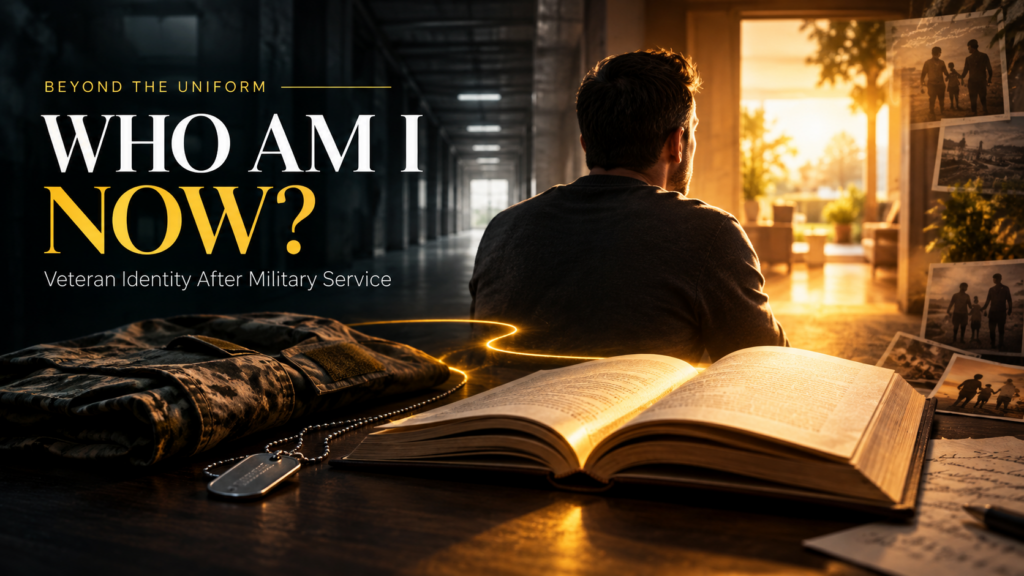
The uniform comes off.
The rank disappears from daily life.
The unit continues without you.
People stop addressing you by a title that once carried meaning.
And eventually, a question can become harder to ignore:
Who am I now?
For some veterans, leaving military service is an exciting beginning.
For others, it creates an unexpected feeling of disorientation.
The challenge is not always finding a job or learning a civilian routine. Sometimes it is rebuilding a sense of self after years inside an institution that shaped how a person worked, belonged, served, communicated, and understood their purpose.
That is why veteran identity after military service deserves attention as its own topic.
Military identity does not have to disappear when service ends.
But it may need to change.
The goal is not necessarily to stop being someone who served.
It may be learning how that part of life fits into a larger identity that also includes family, community, work, creativity, education, friendship, service, and whatever comes next.
Key Takeaways
- Military service can become deeply connected to identity, belonging, purpose, and self-worth.
- Leaving service may involve an identity transition as well as a career transition.
- Some veterans experience uncertainty, loss of purpose, or disconnection after separation.
- Missing military identity does not mean someone made the wrong decision by leaving.
- Healthy adjustment does not require erasing military identity.
- Building new roles, communities, relationships, and sources of meaning can help veterans develop a broader post-service identity.
- There is no single correct way to be a veteran.
Why Can Military Identity Become So Strong?
Military service is more than an occupation.
A civilian job may shape part of someone’s identity.
Military service can influence far more.
It may affect:
- Where someone lives
- Who they spend time with
- How they dress
- How they communicate
- Their daily schedule
- Their responsibilities
- Their physical standards
- Their community
- Their understanding of duty
- Their sense of belonging
- Their relationship with risk
- Their idea of service and sacrifice
People may also become strongly connected to a branch, specialty, unit, rank, mission, or group of fellow service members.
Instead of simply saying:
“I work for the military.”
someone may think:
“I am a Marine.”
“I am a soldier.”
“I am an airman.”
“I am a sailor.”
That language matters.
It shows how occupation can become identity.
So when service ends, the veteran may not simply be changing employers.
They may be leaving a social world that helped answer the question:
“Who am I?”
Identity After Military Service Can Feel Like a Loss Even When Separation Is Positive
A veteran does not have to regret leaving the military to miss what military life provided.
Someone may be completely ready to leave behind:
- Deployments
- Frequent moves
- Time away from family
- Bureaucracy
- Physical strain
- Dangerous environments
- Limited control over assignments
And still miss:
- Camaraderie
- Mission
- Teamwork
- Responsibility
- Shared language
- Clear standards
- Recognition
- Belonging
Those feelings are not contradictory.
A person can be ready for the next chapter and still grieve the one that ended.
That is one reason identity after military service can be complicated.
The veteran may have wanted civilian freedom but not expected how strange it would feel to lose the structure surrounding their previous identity.
Recent Research Connects Veteran Identity With Meaning and Purpose
This is not simply a storytelling idea.
Recent research has examined the relationship between military transition, identity, meaning, purpose, and wellbeing.
A 2026 scoping review published in Behavioral Sciences examined 15 studies on veterans transitioning from full-time military service.
The review found recurring evidence of identity disruption and loss of meaning or purpose during transition, with these experiences associated with poorer wellbeing in the studies reviewed.
The researchers also emphasized an important point:
Successful transition is not necessarily about abandoning military identity.
It may involve renegotiating that identity alongside new roles, relationships, communities, and sources of meaning.
That distinction changes the conversation.
The question does not have to be:
“How do I stop being military?”
A more useful question may be:
“How does the person I became during military service fit into the person I want to become next?”
Veteran Identity Loss Is Not Always About Losing a Title
People sometimes imagine veteran identity loss as simply missing a uniform or rank.
It can run much deeper.
A role can provide several things at once:
Recognition
Other people understand what you do and what is expected of you.
Belonging
You are part of a defined group.
Competence
You know the environment and understand how to operate inside it.
Purpose
Your responsibilities connect to a larger mission.
Status
Rank and experience establish a clear position within the organization.
Community
You spend significant time around people who share the same culture.
When all of those elements change together, the veteran may struggle to identify exactly what they miss.
It may not be the job itself.
It may be everything that surrounded it.
From “We” to “Me”
Military culture often emphasizes the team.
The unit.
The mission.
The group.
Individual preferences may matter less than what the organization needs.
Then military service ends.
Civilian life often asks very different questions:
What do you want?
Where do you want to live?
What career do you want?
What makes you happy?
What does success mean to you?
For someone accustomed to thinking in terms of collective responsibility, these questions can feel surprisingly difficult.
The 2026 research review describes this movement from a strong collective military identity toward a more individually defined civilian identity as an important element of transition.
Freedom can be exciting.
It can also feel disorienting when the structure that previously organized major life decisions disappears.
Why “What Do You Do?” Can Become an Uncomfortable Question
Civilian introductions often begin with employment.
“What do you do?”
For someone who recently separated, the answer may suddenly feel unclear.
A veteran may know exactly who they were six months ago.
Platoon sergeant.
Medic.
Pilot.
Mechanic.
Intelligence analyst.
Logistics specialist.
Military police officer.
Now perhaps they are a student.
Between jobs.
Starting a business.
Working in an unrelated civilian field.
Or still trying to decide what comes next.
The problem is not that these new roles are less valuable.
The problem is that they may not yet feel connected to the veteran’s sense of self.
Identity often develops through repetition.
The military identity took time to form.
A civilian identity can take time too.
Finding Purpose After Military Service Can Be Harder Than Finding Employment
A job can provide income.
Purpose is something different.
Military service often connects everyday responsibilities to a larger mission.
Someone may know that other people depend on their performance.
They may understand exactly what failure means.
The work may contribute to a unit, operation, or mission larger than themselves.
Civilian employment may initially feel different.
A veteran can obtain a perfectly good job and still think:
“Why doesn’t this feel important?”
That does not mean civilian work lacks value.
It may mean the veteran is comparing a new role against a previous environment where purpose was unusually explicit.
This is why finding purpose after military service may require looking beyond job titles.
Purpose can come from:
- Family
- Community leadership
- Mentoring
- Education
- Public service
- Entrepreneurship
- Creative work
- Volunteerism
- Coaching
- Advocacy
- Faith
- Building something new
The next mission does not have to look like the previous one.
Belonging Can Be Harder to Replace Than Structure
Many aspects of military life can be recreated in civilian life.
A schedule can be built.
Fitness can continue.
A new career can provide responsibilities.
But belonging can be harder.
Military relationships may develop under unusual conditions.
People train together.
Deploy together.
Share difficult assignments.
Depend on each other.
Live near each other.
Work long hours together.
Develop their own humor and language.
Civilian relationships can be meaningful too.
But they may not develop under the same intensity.
That can leave some veterans feeling surrounded by people but not fully understood.
They may think:
“These are good people. They just don’t get that part of me.”
That feeling can strengthen nostalgia for military life.
Sometimes what the veteran misses most is not the institution.
It is being around people who required very little explanation.
Strong Military Identity Is Not Automatically a Problem
This point matters.
Being proud of military service is not unhealthy.
Maintaining relationships with fellow veterans is not a problem.
Using skills or values developed during service is not a failure to move on.
Military identity can remain a meaningful and positive part of someone’s life.
The challenge may arise when it becomes the only identity that feels meaningful.
The recent review of identity, meaning, and purpose during military-to-civilian transition found that in several of the studies reviewed, very central or exclusive military identity was associated with greater difficulty adjusting when comparable civilian roles and relationships had not yet developed.
That is an important nuance.
The solution is not necessarily:
Military identity → remove it.
It may be:
Military identity → integrate it into something larger.
You Can Be a Veteran Without Being Only a Veteran
Identity is rarely one thing.
A person can simultaneously be:
A veteran.
A parent.
A spouse.
A friend.
A writer.
A mechanic.
A student.
A coach.
A business owner.
A volunteer.
A musician.
A neighbor.
A mentor.
A member of a community.
The veteran identity does not need to compete with all of those roles.
It can become one part of them.
This broader identity can also reduce the feeling that leaving military service means losing the only version of yourself that mattered.
You are not erasing the past.
You are adding to it.
Civilian Life May Not Provide the Same Recognition
Military achievement is often visible.
There are ranks.
Qualifications.
Awards.
Badges.
Evaluations.
Promotions.
Clear milestones.
Civilian identity can feel more ambiguous.
A veteran may have enormous responsibility during military service and then enter a civilian role where nobody understands what they previously managed.
That can feel like a loss of status.
Imagine someone who once led dozens of people in a demanding environment.
Now they are explaining basic military terminology during an interview to someone who has no idea what their previous position involved.
The veteran may think:
“Do they understand what I was responsible for?”
Sometimes they do not.
That experience can make military identity feel even more important because it remains the place where the person’s competence feels fully recognized.
Part of adjustment may involve learning to value experience even when other people do not immediately understand its significance.
Purpose Does Not Have to Be as Dramatic as the Previous Mission
This is another difficult comparison.
Military responsibility can involve unusually high stakes.
Then civilian life arrives.
A deadline at work may not feel like a mission.
A quarterly target may not feel consequential.
Everyday civilian responsibilities can initially seem small.
But purpose does not require danger.
Helping raise a child can have purpose.
Teaching someone can have purpose.
Building a company can have purpose.
Supporting a community can have purpose.
Writing can have purpose.
Taking care of family can have purpose.
The scale may look different.
That does not make the meaning smaller.
Part of adjusting after military service can involve learning to recognize forms of purpose that do not resemble the environment where purpose was previously experienced.
Veterans May Miss Being Needed
Purpose and belonging often overlap through one powerful feeling:
People needed me.
A unit needed your expertise.
A partner needed you to perform.
People trusted you with responsibilities.
The mission required something from you.
Civilian freedom can sometimes remove that feeling.
Nobody assigns the next objective.
Nobody tells you where to be.
Nobody is checking whether your team is ready.
That freedom sounds ideal until the veteran realizes that being needed was part of what made life feel meaningful.
The next chapter may therefore involve finding places where skills, experience, and responsibility matter again.
Not because someone needs orders.
Because humans often need significance.
Identity Reconstruction Does Not Mean Reinventing Yourself Overnight
The phrase “find yourself” can make identity transition sound simple.
It is not.
Someone who spent many years in military service may not immediately know what they want outside that environment.
And they do not have to.
Identity can be rebuilt gradually.
Someone may try a civilian career and decide it is not right.
They may go back to school.
Move.
Start something.
Fail at something.
Discover an interest they never had time to explore while serving.
Reconnect with family.
Find community outside veteran spaces while still maintaining veteran friendships.
A post-service identity is not usually one big realization.
It can develop through many smaller experiences.
Military Values Can Continue Without Military Structure
Veterans sometimes worry that leaving military culture means losing qualities they valued about themselves.
It does not have to.
Discipline can remain.
Service can remain.
Responsibility can remain.
Leadership can remain.
Commitment can remain.
Teamwork can remain.
Courage can remain.
What changes is where those qualities are applied.
A former service member might use leadership in business.
Discipline in education.
Service in community work.
Responsibility in family life.
Mentorship with younger veterans.
The values survive even when the institutional structure changes.
That is one way military identity after service can become integrated rather than abandoned.
New Communities Can Expand Belonging
Veterans do not have to choose between military friends and civilian relationships.
Both can matter.
New belonging may come from:
- Professional organizations
- Sports
- Volunteer groups
- Neighborhood communities
- Faith communities
- Veteran organizations
- Creative groups
- Education
- Parenting communities
- Business networks
The goal is not necessarily replacing military camaraderie.
Some relationships cannot be replicated exactly.
The goal may be building additional places where the veteran can belong.
That distinction matters.
Replacement implies the old relationships no longer matter.
Expansion allows old and new communities to coexist.
When Identity Questions Become More Than an Adjustment Period
Not every veteran who misses military life is experiencing a mental health problem.
Not every period of uncertainty is a crisis.
Major life transitions can naturally involve grief, confusion, nostalgia, and experimentation.
But persistent distress is worth taking seriously.
If loss of identity or purpose is accompanied by severe isolation, depression, substance problems, inability to function, hopelessness, or thoughts of self-harm, professional support may be appropriate.
Identity questions can coexist with PTSD, depression, anxiety, grief, physical injuries, or other concerns.
They can also occur without any psychiatric diagnosis.
A person does not need to wait until life becomes unmanageable before speaking with someone.
A Simple NEXT Framework for Building Identity Beyond Service
Veterans do not need one universal formula for life after service.
But the NEXT framework can help organize the process.
N: Name What You Miss
Is it the military itself?
Or are you missing:
- Camaraderie?
- Structure?
- Purpose?
- Recognition?
- Responsibility?
- Belonging?
Knowing what is actually missing makes it easier to find new ways to meet that need.
E: Expand Your Roles
Do not force your entire identity into one new job.
Explore family, community, education, hobbies, leadership, service, and relationships.
X: eXamine What Comes Forward
Which military values and strengths still fit the person you want to become?
Keep those.
Not everything has to stay.
Not everything has to disappear.
T: Target New Meaning
Ask:
What matters enough that I want to invest part of my life in it now?
Purpose often grows from action rather than appearing fully formed before action begins.
Do This, Not That When Rebuilding Identity After Service
| Do This | Not That |
| Keep meaningful parts of military identity | Assume you must erase your past |
| Build additional roles and communities | Make one new job responsible for your entire identity |
| Identify what you actually miss | Assume you simply “miss the military” |
| Give identity time to develop | Expect to know your next purpose immediately |
| Translate military values into civilian life | Assume those values only matter in uniform |
| Maintain veteran friendships | Isolate yourself entirely inside your former identity |
| Build civilian connections too | Assume civilians can never understand anything about you |
| Explore new sources of purpose | Compare every civilian experience to military intensity |
| Seek support if distress becomes persistent | Interpret every difficult adjustment as personal failure |
The Question Is Not “Who Was I?” but “Who Am I Becoming?”
The past matters.
Military service may have shaped someone’s adulthood more than almost anything else they experienced.
It may have created friendships, confidence, discipline, pain, grief, pride, responsibility, and memories that never completely disappear.
But identity cannot live only in the past.
Eventually, the veteran faces a forward-looking question.
Not:
“Who was I in uniform?”
But:
“Who am I becoming now?”
That does not require rejecting the person who served.
It requires allowing that person to keep growing.
When Fiction Explores the Identity That Comes Home From War
Research can explain identity disruption.
Psychology can describe meaning and belonging.
Transition resources can offer practical guidance.
But stories can explore the part that is difficult to measure:
What does it feel like when the person who comes home no longer experiences themselves exactly the way they did before?
That question connects naturally with The Longest War – Entry II.
The novel follows Julius Fernandez, a Millennial whose life is shaped by the Global War on Terrorism.
Trapezoid Media’s description does not treat war as something confined to an overseas battlefield. Julius’s journey connects military conflict with distance from family, grief, social tensions, identity, and the ways war can continue changing someone’s perspective long after the immediate conflict.
That is why the story is relevant to a discussion about veteran identity after military service.
The central human question is larger than:
“Did the veteran come home?”
It becomes:
“Who came home?”
How has the person changed?
How do they understand the life they left behind?
How do they reconnect with family and community?
What parts of military experience remain inside their identity?
And how do they build a future without pretending the past never happened?
For readers already thinking about purpose, belonging, and identity beyond the uniform, The Longest War offers a fictional way to sit with those questions rather than simply read a checklist about them.
Why Demetrius Hernandez’s Background Adds Context
The connection between military experience and the novel’s themes also becomes more meaningful when readers understand the author’s background.
According to Demetrius Hernandez’s biography, he served in Afghanistan during Operation Enduring Freedom, later worked with the Department of Defense, and earned a master’s degree in Peace Operations from George Mason University.
Trapezoid Media describes those experiences as contributing depth and authenticity to his writing.
That does not mean Julius Fernandez should be treated as an autobiography of the author.
Fiction remains fiction.
But Hernandez’s background provides useful context for readers interested in why themes of war, service, identity, social conflict, and life after military experience appear naturally within the work.
There is a difference between writing about military identity only as an abstract concept and writing with personal familiarity with military environments behind the storytelling perspective.
Readers can learn more about Demetrius Hernandez before exploring how those broader experiences inform his fiction.
Why Stories About Veterans Need More Than the “Broken Veteran” Stereotype
Veterans in fiction are sometimes reduced to one image.
The angry veteran.
The traumatized veteran.
The veteran who cannot fit in.
The hero who misses combat.
Real identity is more complicated.
Someone can struggle with belonging and still build a successful civilian life.
They can miss military friends without wanting to reenlist.
They can experience grief while also feeling hopeful.
They can remain proud of service while questioning parts of what they experienced.
They can carry military identity without allowing it to define every part of them.
This complexity matters because life after leaving the military is not one universal story.
The transition can include difficulty.
It can also include growth.
Beyond the Uniform Does Not Mean Without the Past
The hardest part of veteran identity after military service may be realizing that there is no button that switches someone instantly from “military” to “civilian.”
Identity does not work that way.
A veteran may carry military habits for years.
Military friendships may remain among the most important relationships in their life.
Values developed during service may shape how they raise children, lead teams, approach responsibility, or respond to adversity.
Memories may continue influencing how they see the world.
None of that means the veteran failed to transition.
It means the past became part of the person.
The challenge is making room for a future beside it.
That future might include a different career.
A family.
Creative work.
New friendships.
Community leadership.
Education.
Business.
Service in another form.
Or an identity that cannot be summarized by one title at all.
The goal does not have to be:
“I am no longer the person I was in the military.”
It can become:
“Military service is part of who I am, but it is not the end of who I can become.”
That is a much larger identity.
And for readers who want to explore those questions through story rather than research alone, The Longest War – Entry II moves into the human territory where war, grief, family, identity, and what comes afterward begin to overlap.
Because the uniform may eventually come off.
The work of deciding who you are afterward can become a different kind of journey.
Frequently Asked Questions
What is veteran identity after military service?
Veteran identity refers to how someone understands themselves in relation to their previous military service after leaving active service. It can include pride, values, relationships, experiences, and continued identification with the military alongside new civilian roles.
Why do some veterans experience identity loss?
Military service can provide a clear role, community, hierarchy, purpose, and shared culture. When several of these change at once, some veterans may experience uncertainty about who they are outside the military environment.
Is veteran identity loss a mental health condition?
No. Identity disruption is not automatically a mental health disorder. It can be part of a major life transition, although persistent identity-related distress may coexist with other psychological concerns.
Do veterans have to leave their military identity behind?
No. Research increasingly suggests that transition can involve integrating military identity with new civilian roles rather than completely discarding it.
Why is finding purpose after military service difficult?
Military service can provide an explicit mission and clear responsibility. Civilian life may require veterans to define purpose more independently through work, family, community, education, service, creativity, or other areas.
Why do veterans miss military camaraderie?
Military relationships can form under intense shared experiences, responsibility, training, deployments, and mutual dependence. Those relationships may feel difficult to replicate in ordinary civilian settings.
Can someone be happy to leave the military and still miss it?
Yes. A veteran can be glad to leave certain aspects of service while still missing the people, structure, mission, or sense of belonging.
How can veterans build a new identity?
There is no single method. New identity can develop through relationships, careers, education, hobbies, family roles, community involvement, veteran groups, creative work, or other meaningful experiences.
Does military identity ever disappear?
It does not have to. For many people, military service remains an important part of personal history and identity while becoming one element within a broader civilian life.
Is a new civilian career enough to replace military purpose?
Not always. Employment can be meaningful, but purpose may also come from relationships, community, service, creativity, family, mentorship, and goals outside work.
Can maintaining veteran friendships help?
Yes. Military relationships can provide continuity and understanding. At the same time, developing additional civilian relationships and communities can broaden a veteran’s sense of belonging.
What does current research say about veteran identity and transition?
A 2026 scoping review of veteran identity, life meaning, purpose, and wellbeing found that identity disruption and loss of meaning or purpose were recurring themes during transition. The review also suggests that developing new roles, relationships, and sources of purpose may be important to adjustment.
Is military identity always harmful after service?
No. Military identity can remain meaningful and positive. Difficulties may arise when it remains the only meaningful source of belonging or identity and new roles and relationships have not yet developed.
What does The Longest War have to do with veteran identity?
The Longest War – Entry II explores a fictional character whose life is shaped by the Global War on Terrorism, including themes involving distance from family, grief, identity, social conflict, and battles that continue beyond the war zone.