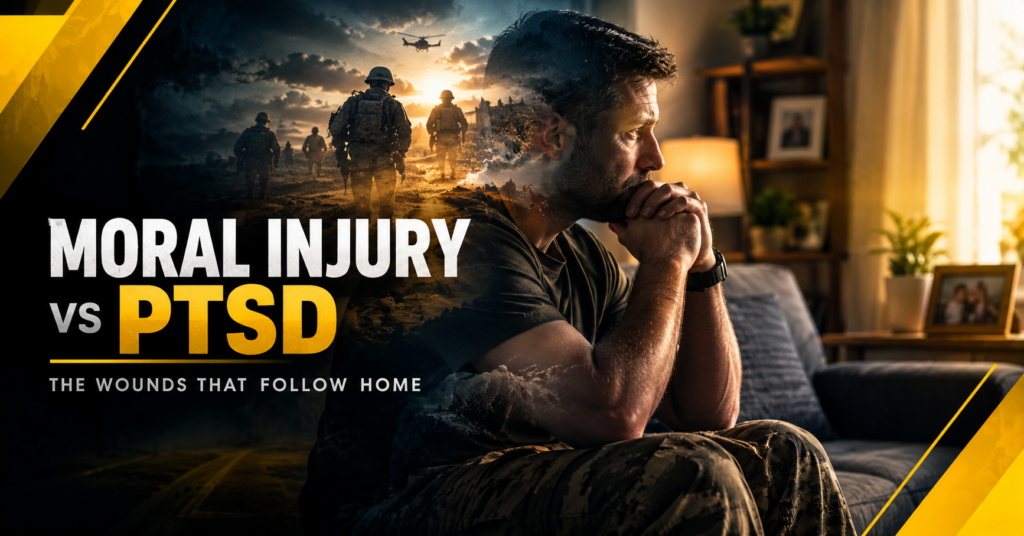
A person can leave a war zone and still feel as though part of the war came home with them.
For one veteran, a sudden noise may bring back the feeling of immediate danger.
Another may avoid crowded places because their body still expects something to go wrong.
But someone else may be haunted by a different kind of question:
“Did I do the right thing?”
“Why couldn’t I save them?”
“How am I supposed to live with what happened?”
These experiences help explain why the conversation around moral injury vs PTSD matters.
Posttraumatic stress disorder, or PTSD, is a recognized mental health condition that can develop after trauma. Moral injury is not currently a psychiatric diagnosis. It refers to lasting psychological, social, behavioral, and sometimes spiritual distress connected to experiences that violate a person’s deeply held moral beliefs or values.
The two can overlap.
But they are not interchangeable.
Understanding PTSD vs moral injury can help veterans, families, and readers better understand why the psychological effects of combat are not always only about fear.
Sometimes the deepest struggle is about guilt, shame, betrayal, identity, and what a person believes about themselves after war.
Key Takeaways
- PTSD is a recognized mental health diagnosis. Moral injury is not a formal psychiatric diagnosis.
- PTSD may involve intrusive memories, avoidance, negative changes in mood or thinking, and heightened alertness after trauma.
- Moral injury often involves guilt, shame, betrayal, anger, self-condemnation, or difficulty forgiving oneself.
- A veteran can experience moral injury without having PTSD.
- PTSD and moral injury can also occur together.
- Combat moral injury may affect relationships, identity, trust, spirituality, and a person’s sense of meaning long after military service ends.
What Is Moral Injury?
Moral injury can develop when someone participates in, witnesses, fails to prevent, or learns about an event that conflicts with deeply held beliefs about what is right or wrong.
The U.S. Department of Veterans Affairs’ National Center for PTSD explains that these experiences can lead to lasting guilt, shame, anger, betrayal, difficulty forgiving oneself, changes in relationships, and even spiritual distress.
In a military setting, that might involve:
- Making a decision during combat that later feels impossible to accept
- Being unable to save someone
- Witnessing severe harm
- Following an order that conflicts with personal values
- Feeling that leadership betrayed its responsibilities
- Failing to act during an overwhelming situation
- Surviving when friends or fellow service members did not
The important point is not simply that something terrible happened.
The person may believe that a moral boundary was crossed.
That belief can remain powerful long after the immediate danger has passed.
What Is PTSD?
PTSD can develop after exposure to certain traumatic events.
It is not simply being upset about something that happened.
The National Center for PTSD’s overview of PTSD explains that symptoms can include reliving or re-experiencing trauma, avoiding reminders, negative changes in thoughts and feelings, and becoming unusually reactive or alert.
A veteran with PTSD may experience:
- Nightmares
- Intrusive memories
- Flashbacks
- Avoidance of trauma reminders
- Difficulty sleeping
- Feeling constantly on guard
- Being easily startled
- Emotional numbness
- Irritability
- Persistent negative thoughts or feelings
Not every person who goes through combat develops PTSD.
And having difficult memories after military service does not automatically mean someone has a disorder.
Diagnosis depends on a specific pattern of symptoms, duration, and impact on functioning and should be made by an appropriate professional.
Moral Injury vs PTSD: What’s the Main Difference?
A useful way to begin understanding the difference is to think about the central conflict.
PTSD may involve the nervous system continuing to react as though danger is still present.
Moral injury may involve the mind and conscience continuing to struggle with what the person believes happened morally.
In very simple terms:
PTSD can ask: “Am I safe?”
Moral injury can ask: “Can I live with what happened?”
Real experiences are more complicated than those two questions, but they highlight an important distinction.
| Area | Moral Injury | PTSD |
| Formal mental health diagnosis | No | Yes |
| Common central themes | Guilt, shame, betrayal, anger, moral conflict | Trauma, fear, avoidance, intrusive memories, hyperarousal |
| Self-forgiveness difficulties | Can be central | Can occur |
| Feeling constantly on guard | Not usually a defining feature | Common |
| Spiritual or existential conflict | Can be prominent | Can occur |
| Can occur without the other | Yes | Yes |
| Can occur together | Yes | Yes |
Moral injury and PTSD can share guilt, shame, loss of trust, and emotional distress.
That overlap is one reason they can be confused.
But the internal experience may be very different.
Moral Injury in Veterans: Why Combat Can Create a Unique Conflict
War can force people into decisions that ordinary civilian life rarely requires.
There may be seconds to decide.
Information may be incomplete.
Every available option may carry a cost.
Someone may be responsible for other people’s lives without having full control over the situation.
A medic may be unable to save everyone.
A service member may witness something they feel should never have happened.
A leader may make a decision knowing that someone could die regardless of the choice.
During the event, survival may require action.
Afterward, the mind may begin judging those actions from a completely different environment.
That is where moral injury in veterans can become especially difficult.
The veteran is no longer making the decision.
Now they are remembering it.
Replaying it.
Reinterpreting it.
And sometimes judging themselves for it.
What Can Combat Moral Injury Feel Like?
There is no official checklist of moral injury symptoms because moral injury is not a formal diagnosis.
It is more accurate to talk about common reactions.
These may include:
- Persistent guilt
- Shame
- Anger
- Betrayal
- Disgust
- Loss of trust
- Difficulty forgiving oneself
- Feeling undeserving of happiness
- Emotional withdrawal
- Self-punishing behavior
- Loss of meaning
- Changes in spiritual beliefs
A veteran may think:
“I failed someone.”
“I should have done more.”
“I don’t deserve the life I have now.”
“I cannot forgive myself.”
“The institution I trusted betrayed what it claimed to stand for.”
Those thoughts show why moral injury can affect much more than mood.
It can reach into identity.
Veteran Guilt After Combat Can Become an Identity Struggle
Guilt is not unique to moral injury.
It can occur with grief, depression, PTSD, and many other experiences.
But veteran guilt after combat can become especially significant when the person believes that they violated an important moral responsibility.
There is also a difference between guilt and shame.
Guilt may sound like:
“I did something wrong.”
Shame may become:
“I am a bad person because of what happened.”
That second belief can be much harder to carry.
It transforms one event into a judgment about the entire self.
A veteran may begin to believe that they do not deserve a close relationship, success, happiness, forgiveness, or even peace.
The past stops being something they remember.
It becomes something they use to define themselves.
Moral Injury Can Come From Betrayal Too
A morally injurious experience does not always involve something the veteran personally did.
Betrayal can also be central.
The VA’s professional guidance on moral injury includes experiences involving leaders, peers, or others in positions of power whose actions violate important moral expectations.
A service member may feel that:
- Leadership abandoned them
- Someone in authority made an unacceptable decision
- Rules were applied unfairly
- An institution failed to protect people
- Values used to justify service were not honored in practice
This type of experience can damage more than trust in one person.
It may change how the veteran sees authority, institutions, loyalty, and even their own service.
Why Moral Injury Can Affect Relationships
A person struggling with moral injury may not want to explain what happened.
They may believe:
“No one would understand.”
Or worse:
“If they knew, they would think differently about me.”
That fear can create distance from spouses, children, friends, and other veterans.
Someone may stop talking about deployment.
They may avoid affection.
They may become emotionally detached.
They may believe they do not deserve to be close to people they love.
Over time, silence can become isolation.
And isolation can give guilt and shame more room to grow.
Moral Injury Can Change Faith and Meaning
War can also challenge beliefs that once gave a person’s life structure.
A veteran may return with questions such as:
“Why did they die and I survive?”
“How could this have been allowed to happen?”
“Can someone like me be forgiven?”
“What do my values mean now?”
“Was any of it worth it?”
The VA notes that moral injury may include spiritual crisis or difficulty reconciling an experience with religious or moral beliefs.
That does not mean everyone with moral injury becomes religious or loses faith.
It means the conflict can reach a very fundamental level:
What kind of world do I believe I live in now?
Can Someone Have Moral Injury Without PTSD?
Yes.
Moral injury can occur without PTSD.
PTSD can also occur without moral injury.
Imagine two service members who experience the same event.
One later develops nightmares, avoidance, hypervigilance, and intense physical reactions to reminders of the event.
The other does not feel constantly threatened but remains consumed by guilt over a decision they made during it.
Both may be suffering.
But the psychological mechanisms are not necessarily identical.
That is why treating PTSD vs moral injury as a simple either-or choice misses the point.
Human responses to war rarely fit into perfectly separated categories.
What If Moral Injury and PTSD Happen Together?
They can.
Someone may be traumatized by the danger of an event while also feeling morally responsible for what happened during it.
Imagine a veteran who keeps reliving a combat event.
The memory brings fear.
But it also brings guilt.
They avoid thinking about it because it feels terrifying.
But they also avoid thinking about it because they feel ashamed.
That person may become trapped between two painful reactions:
“I don’t want to remember what happened.”
and
“I cannot forgive myself for what happened.”
The VA reports that when moral injury and PTSD occur together, PTSD and depression symptoms may be more severe.
This is one reason understanding the distinction matters.
Moral Injury After War Can Continue Long After Deployment Ends
Military service has clear external markers.
A deployment begins.
A deployment ends.
A person returns home.
Uniforms are put away.
Family routines start again.
The internal transition can be much less orderly.
A veteran may still be trying to understand:
- Who they were before deployment
- Who they became during war
- Who they lost
- What they witnessed
- What they did
- What they could not do
- Why they survived
- Who they are supposed to become now
This is one of the hardest psychological effects of combat to capture in a simple medical definition.
The battlefield can become physically distant while remaining emotionally present.
Historical Context: A Generation Shaped by a Long War
The historical setting matters too.
The War in Afghanistan from 2001 to 2021 began following the September 11 attacks and became a conflict spanning roughly two decades.
For many Millennials, the Global War on Terror was not one isolated historical event.
It was part of the background of growing into adulthood.
Some served.
Some watched family members deploy repeatedly.
Some lost friends.
Some came home and attempted to build ordinary lives after extraordinary experiences.
A military timeline can tell us when operations began and ended.
It cannot fully explain what those years meant to the individual people inside them.
That is where history and moral injury intersect.
History tells us where and when people served.
Moral injury asks what some of them carried away from those experiences.
Why “Coming Home” May Not Feel Like the End
Coming home sounds like an ending.
For some veterans, it is the beginning of a different conflict.
The immediate threat may be gone, but the questions remain.
A person may now be trying to fit battlefield experiences into a civilian identity.
At home, other people may be worried about careers, relationships, bills, family events, and everyday frustrations.
The veteran may be trying to participate in that life while carrying memories that feel impossible to explain.
This can create a strange separation.
Physically, the veteran is home.
Emotionally, part of them may still be somewhere else.
That is one reason stories about war often become most revealing after the shooting stops.
When War Follows Someone Home: The Longest War
Clinical language helps us understand moral injury.
History helps us understand the conflict.
But neither can completely show what it feels like to carry a war into ordinary life.
Stories can explore that space differently.
In Diaries From The Forsaken: Entry II, The Longest War, Julius Fernandez is presented as a Millennial shaped by the Global War on Terrorism.
The story moves beyond the idea of war as something contained overseas.
It connects conflict with distance from family, grief, social tensions, identity, and the struggle to continue living after experiences that change how a person sees the world.
That makes the novel especially relevant to readers thinking about moral injury after war.
The question is not simply:
What happened during the war?
It becomes:
What happens to someone after they survive it?
How does grief affect identity?
How does someone return to people who did not experience what they experienced?
What happens when the person who comes home no longer feels exactly like the person who left?
And what happens when conflict abroad collides with struggles waiting at home?
Those questions are where The Longest War connects naturally with the subject of moral injury.
It is not a psychology textbook.
It does something different.
It puts a person inside the consequences.
For readers interested in the human side of war rather than another timeline of battles and political decisions, exploring The Longest War offers a story centered on what can remain after the battlefield itself is gone.
Why the Author’s Background Matters to the Story
Authenticity in military fiction is not only about knowing equipment, terminology, or locations.
It can also come from understanding the atmosphere of military service and what prolonged conflict can mean to the people living through it.
According to his author biography, Demetrius Hernandez served in Afghanistan during Operation Enduring Freedom before working with the Department of Defense. He also earned a master’s degree in Peace Operations.
Those experiences form part of the background behind his storytelling.
That does not mean Julius Fernandez should be read simply as the author’s autobiography.
Fiction remains fiction.
But knowing the author’s connection to military service adds another dimension for readers interested in stories about war, identity, grief, and life after conflict.
The subject is not being approached only from a distance.
There is lived historical context behind the storyteller.
Understanding Moral Injury Does Not Mean Diagnosing Yourself
Readers may recognize themselves or someone they know in parts of this discussion.
That does not mean a person should self-diagnose.
Moral injury is not itself a formal diagnosis, and symptoms such as guilt, shame, anxiety, nightmares, isolation, anger, depression, or difficulty sleeping can occur in many different circumstances.
A qualified mental health professional can help evaluate what is actually happening.
For veterans experiencing PTSD symptoms, the VA’s National Center for PTSD provides information about assessment and evidence-based treatment.
The goal is not to erase history.
No therapy can make an event unhappen.
The goal is to help someone build a life in which the past does not control every part of the present.
A Simple Way to Remember PTSD vs Moral Injury
Think of two different wounds.
The Threat Wound
The mind and body continue responding as though danger has not fully ended.
This can be associated with PTSD symptoms such as hypervigilance, intrusive memories, avoidance, or exaggerated startle responses.
The Moral Wound
The person continues struggling with what an event means about right and wrong, responsibility, trust, forgiveness, or identity.
This is closer to the idea of moral injury.
Some veterans carry one.
Some carry the other.
Some carry both.
That is why conversations about military mental health need room for more than one kind of suffering.
The Difference Matters Because War Can Leave More Than One Kind of Wound
The conversation around moral injury vs PTSD matters because people do not all carry military experiences in the same way.
One veteran may struggle with nightmares.
Another may remain constantly alert.
Another may be unable to forgive themselves.
Another may feel betrayed by the institution they once trusted.
Some may experience several of those reactions together.
PTSD gives us a framework for understanding one set of trauma-related symptoms.
Moral injury gives us language for another difficult question:
What happens when war does not only threaten someone’s safety, but also changes what they believe about themselves, other people, and what is right?
That question reaches beyond diagnosis.
It reaches into identity.
Into grief.
Into relationships.
Into memory.
Into the difficult process of becoming a civilian again when part of the person is still trying to understand what happened during war.
History can tell us when a conflict began and ended.
Psychology can help explain some of its effects.
But stories can make us sit with the person who has to continue living after the history is over.
That is the space explored in The Longest War.
Not simply the battlefield.
But what follows it.
Because sometimes the longest war is the one that continues after everyone else thinks the fighting has ended.
Frequently Asked Questions
What is the difference between moral injury and PTSD?
PTSD is a recognized mental health disorder that can develop after trauma. Moral injury is not a formal diagnosis. It describes lasting distress associated with experiences that violate deeply held moral beliefs or values.
Is moral injury a type of PTSD?
No. The two can overlap, but moral injury is not a subtype of PTSD. A person can experience moral injury without meeting criteria for PTSD.
What causes moral injury in veterans?
Potential causes include participating in, witnessing, or failing to prevent events that conflict with deeply held values. Betrayal by trusted leaders or institutions can also contribute.
What are common signs associated with moral injury?
Common reactions include guilt, shame, anger, betrayal, disgust, inability to forgive oneself, withdrawal from relationships, loss of meaning, and spiritual conflict.
What does moral injury in the military look like?
It may involve distress about actions taken during combat, decisions affecting others, inability to save someone, witnessing conduct perceived as wrong, or feeling betrayed by leadership.
Can combat cause both PTSD and moral injury?
Yes. A traumatic combat event can contribute to PTSD while the meaning attached to actions or decisions during that event contributes to moral injury.
Can veterans have moral injury without being afraid?
Yes. Fear does not have to be the dominant emotion. Moral injury may center more heavily on guilt, shame, betrayal, anger, or self-condemnation.
Why do some veterans feel guilty after surviving combat?
Survivor guilt can involve feeling that one should have died instead of someone else, should have saved another person, or should have prevented an outcome. These reactions can occur with grief, PTSD, moral injury, and other forms of distress.
Is moral injury a mental illness?
Moral injury is not currently classified as a psychiatric diagnosis. It is a concept used to describe lasting distress after experiences that violate deeply held morals or values.
Does moral injury affect relationships?
It can. Shame, guilt, mistrust, withdrawal, and beliefs about being undeserving of love or happiness may make close relationships more difficult.
Can moral injury affect faith?
Yes. Some people experience spiritual or existential conflict and begin questioning faith, forgiveness, meaning, justice, or previously held beliefs.
Can moral injury be treated?
Researchers continue studying approaches specifically targeting moral injury. When PTSD is also present, established evidence-based PTSD treatments can still be effective for PTSD symptoms.
Where can I read fiction about war and what happens afterward?
Readers interested in war, grief, identity, family distance, and the conflicts that can continue after military service can explore The Longest War, Entry II by Demetrius Hernandez.