Leaving the military can look simple from the outside.
The deployment ends.
The uniform comes off.
A service member returns home, finds a job, reconnects with family, and begins civilian life again.
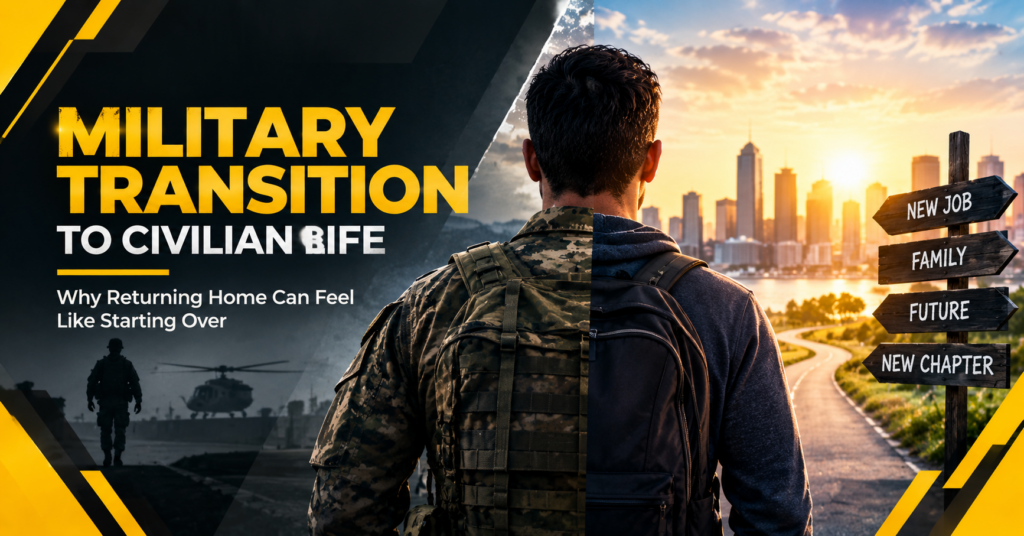
But the military transition to civilian life is rarely just a change of employment.
Military service can shape a person’s routine, relationships, identity, language, responsibilities, sense of purpose, and understanding of belonging. When that structure suddenly changes, returning home can feel less like going back to an old life and more like learning how to live in a new one.
For some veterans, that transition is exciting.
For others, it is confusing.
Many experience both at the same time.
A person can be relieved to leave certain parts of military life behind while still missing the people, structure, mission, and sense of identity that came with it.
That is why adjusting to civilian life after military service can feel like starting over, even when someone is returning to a place they once called home.
Key Takeaways
- Transitioning out of the military involves more than finding civilian employment.
- Veterans may need to adjust to major changes in identity, routine, relationships, community, and purpose.
- Military skills can be valuable in civilian careers but may need to be translated into language employers understand.
- Family members are also affected by the transition.
- Missing aspects of military life does not necessarily mean someone regrets leaving it.
- A successful military civilian transition can take time and may involve practical, emotional, social, and professional adjustment.
Why Can Leaving Military Life Feel So Disorienting?
Military life gives people a structure.
There are schedules.
Standards.
Ranks.
Responsibilities.
Clear expectations.
A chain of command.
A shared language.
And often a strong understanding of how your individual role contributes to a larger mission.
Civilian life may offer more freedom, but freedom can feel strange when someone has spent years operating inside a highly structured environment.
Suddenly, many decisions that were previously shaped by military life become personal decisions.
Where will you live?
What kind of work will you do?
Who are you when your rank is gone?
How do you explain your experience to people who have never served?
What provides purpose now?
The Military OneSource guide to transitioning to civilian life recognizes that separation can involve questions about employment, housing, education, finances, benefits, relationships, and personal identity.
That range of concerns tells us something important:
Military transition is not one problem to solve.
It is several transitions happening at once.
1. The Uniform Can Become Part of a Person’s Identity
Military service can become deeply connected to how a person understands themselves.
Someone may have spent years thinking:
I am a Marine.
I am a soldier.
I am an airman.
I am a sailor.
I am part of this unit.
That identity carries responsibilities, history, community, and expectations.
Then separation happens.
The person’s experiences remain, but the formal role changes.
Military OneSource describes transition as a period in which former service members begin developing a new identity as veterans while becoming part of civilian communities.
That shift can raise a surprisingly difficult question:
Who am I without the role that defined so much of my life?
This is one reason life after military service cannot be understood only through employment statistics.
A job change is external.
An identity change is personal.
2. Structure Disappears Faster Than Habits Do
Military routines can shape daily life for years.
People become accustomed to:
- Set schedules
- Physical standards
- Clear responsibilities
- Immediate accountability
- Defined leadership
- Established procedures
- Predictable expectations
Civilian workplaces can feel very different.
A manager may communicate indirectly.
Schedules may be flexible.
Responsibilities may be ambiguous.
Coworkers may approach deadlines differently.
Workplace culture may depend heavily on unwritten expectations.
For someone leaving military life, that flexibility can initially feel less organized rather than more freeing.
The challenge is not necessarily learning how to function.
Veterans already know how to function under demanding circumstances.
The adjustment is learning how to operate within a different system.
3. Civilian Work Can Require Veterans to Translate Their Experience
One of the biggest practical veteran transition challenges involves employment.
Military experience can develop skills in:
- Leadership
- Logistics
- Communication
- Technical operations
- Risk management
- Planning
- Team coordination
- Decision-making
- Training
- Crisis response
- Project execution
But civilian employers may not understand military terminology.
A service member might immediately understand what a particular rank, qualification, unit responsibility, or occupational specialty means.
A civilian hiring manager may not.
That creates a translation problem.
The veteran has the experience.
The challenge is communicating its civilian relevance.
Military OneSource specifically advises transitioning service members to translate their military skills and accomplishments into language civilian employers can understand.
For example:
Instead of:
“Served as NCOIC responsible for mission readiness.”
a civilian resume may need to communicate:
“Supervised personnel, coordinated operations, managed resources, and maintained team readiness under demanding deadlines.”
The experience has not changed.
The language has.
4. Finding a Job Is Not the Same as Finding a New Purpose
Employment matters.
Purpose can be harder.
Military work often connects everyday tasks to a larger mission.
A person may know why their job matters.
They may know who depends on them.
They may understand what failure could mean.
After military service, civilian work may initially feel less consequential.
That does not mean civilian careers lack meaning.
It means a veteran may have to redefine what meaningful work looks like.
The question may shift from:
“What is my mission?”
to:
“What do I want my next mission to be?”
That could involve:
- A civilian career
- Education
- Entrepreneurship
- Public service
- Family
- Community work
- Creative work
- Mentoring other veterans
- An entirely different field
Transition is not only about replacing one occupation with another.
It can involve rebuilding a sense of direction.
5. Missing Military Life Does Not Mean Someone Wants to Go Back
People can miss something without wanting all of it back.
A veteran may not miss:
- Deployments
- Long separations
- Lack of control over location
- Bureaucracy
- Physical demands
- Dangerous assignments
But they may deeply miss:
- Camaraderie
- Shared purpose
- Humor
- Trust
- Team identity
- Clear expectations
- Feeling understood without having to explain everything
Those emotions can exist at the same time.
Someone can be glad they separated and still grieve parts of the life they left.
That complexity is normal to the idea of transition itself.
Endings and beginnings can overlap.
6. Losing the Built-In Community Can Be Hard
Military service often creates unusually close relationships.
People train together.
Work long hours together.
Deploy together.
Depend on one another.
Experience difficult situations together.
Those relationships may develop under conditions that civilian friendships rarely encounter.
Then separation can scatter that community.
One person moves to Texas.
Another stays overseas.
Someone retires.
Someone changes careers.
Another person simply becomes busy building a civilian life.
Technology can keep people connected, but connection is different from sharing everyday life.
For veterans returning to civilian life, one of the less visible challenges can therefore be belonging.
A person may be surrounded by coworkers, relatives, and neighbors while still feeling that the people who understand an important part of them are somewhere else.
7. Returning Home Does Not Mean Returning to the Same Family
Service members change.
Families change too.
A spouse may have spent years managing responsibilities during deployments.
Children may have become more independent.
Parents may have aged.
Family routines may have developed without the service member being present every day.
Then someone comes home permanently.
Everyone may be happy about the reunion.
But the household still has to adjust.
A veteran may expect to resume an old role.
The family may have learned to function differently.
A spouse who handled every household decision during deployments may not immediately want to give up that independence.
Children may need time to adjust to another authority figure being present consistently.
This does not mean the family is broken.
It means everyone has been adapting.
Now they have to adapt together.
Military OneSource emphasizes that the transition from military to civilian life affects the entire family, not only the separating service member.
8. Ordinary Civilian Problems Can Feel Surprisingly Strange
Military service can expose people to responsibilities with serious consequences.
Then civilian life may suddenly involve:
Office politics.
Commuting.
Choosing health insurance.
Updating LinkedIn.
Negotiating salary.
Attending parent-teacher meetings.
Looking for housing.
Deciding what to wear to work.
Figuring out how civilian vacation policies work.
None of these things are necessarily harder than military responsibilities.
They are simply different.
And unfamiliarity can make ordinary situations feel frustrating.
A veteran may think:
“I handled situations much harder than this. Why is this bothering me?”
Because competence in one environment does not automatically eliminate the adjustment period required in another.
9. Freedom Can Create Its Own Pressure
Military life can limit personal choice.
Civilian life suddenly offers a lot of it.
Where do you live?
Which career do you pursue?
Should you go back to school?
Do you buy a home?
Should you stay near family?
Do you start a business?
Do you pursue the civilian version of your military job or do something completely different?
Choice sounds liberating.
It can also become overwhelming.
For years, many major decisions may have been influenced by orders, assignments, deployments, promotion requirements, and military needs.
Now the person may have to define success for themselves.
There is no promotion board telling them what comes next.
That uncertainty can make civilian life feel less like freedom and more like standing in front of too many doors.
10. Transition Planning Should Begin Before the Final Day
A healthy transition does not have to begin after separation.
The Department of Veterans Affairs operates the Transition Assistance Program, or TAP, to help service members prepare for civilian life.
The program covers practical areas such as:
- Benefits
- Employment
- Education
- Health care
- Family support
- Housing
- Financial planning
VA guidance recommends starting the transition process before separation, with the timeline depending on whether someone is separating or retiring.
This makes sense.
It is much easier to make major decisions when there is time to explore options than when someone feels pressure to solve everything immediately after leaving.
11. Civilian Success Does Not Require Erasing Military Identity
Sometimes transition is described as though the veteran must simply “become civilian” and leave military identity behind.
That may be too simplistic.
Military service remains part of a person’s history.
The goal does not have to be forgetting it.
The challenge is integrating it.
Someone can think:
“Military service shaped me.”
without believing:
“Military service is the only thing that defines me.”
That distinction creates room for growth.
The past remains important.
But it does not have to prevent a new identity from developing.
12. Adapting After Military Service Can Mean Learning a New Social Language
Military culture has its own vocabulary, humor, expectations, and communication style.
Civilian environments may operate differently.
Direct communication that was normal in one setting may feel unusually blunt in another.
Hierarchy may be less visible.
Authority may be informal.
People may disagree differently.
Workplace friendships may also develop at a different pace.
This is another reason adapting after military service can take time.
Someone is not just changing jobs.
They may be changing cultures.
13. The Transition Can Reveal Things That Were Easy to Ignore While Serving
A demanding military schedule can keep people moving.
There is always another responsibility.
Another training event.
Another deadline.
Another deployment.
Another assignment.
Then civilian life creates space.
Sometimes that space feels peaceful.
Sometimes it allows unresolved experiences to become more noticeable.
Grief may surface.
Questions about purpose may become harder to avoid.
Memories may feel different without the military community nearby.
A veteran may begin reflecting on years of experiences that were previously pushed aside because there was always another mission.
That does not mean every transitioning veteran develops a mental health condition.
But it does mean that life after military service can involve emotional adjustment as well as practical planning.
14. Military Transition Is Not Automatically a Mental Health Crisis
It is important not to pathologize transition itself.
Difficulty adjusting does not automatically mean someone has PTSD, depression, anxiety, or another mental health condition.
Major life transitions can be stressful even when they are ultimately positive.
At the same time, persistent distress deserves attention.
A person may benefit from talking with an appropriate professional if emotional or behavioral difficulties begin significantly interfering with relationships, work, sleep, daily functioning, or safety.
Military OneSource offers confidential support resources for eligible transitioning service members and families, while VA services can provide additional veteran-specific assistance.
Asking for support does not make the transition unsuccessful.
Support can be part of making the transition work.
15. The Veteran Is Not Starting From Zero
Civilian transition can feel like starting over.
But starting over is not the same as starting from nothing.
A veteran may bring years of:
- Leadership experience
- Discipline
- Technical training
- Decision-making ability
- Adaptability
- Teamwork
- Resilience
- Responsibility
- Cross-cultural experience
- Problem solving
The challenge is identifying which lessons should come forward and which parts of military life no longer fit the next chapter.
This distinction matters.
Civilian life does not require deleting the previous identity.
It requires translating it.
A Simple RESTART Framework for Civilian Transition
The word restart fits this stage surprisingly well, but a restart does not mean returning to zero.
Use this framework to think about the transition:
R – Recognize What Is Changing
Military transition affects more than employment. Consider identity, routine, family, finances, health care, friendships, location, and purpose.
E – Explore Your Options
Look at careers, education, benefits, locations, and different ways your military experience can transfer.
S – Separate Rank From Identity
Your rank and position mattered, but they are not the only things that made you capable.
T – Translate Your Experience
Learn how to explain military skills in terms civilian employers, schools, and organizations understand.
A – Accept an Adjustment Period
You do not have to feel completely at home in civilian life immediately.
R – Rebuild Community
Stay connected to people from service while also creating relationships and community in your new environment.
T – Target a New Purpose
Civilian life becomes easier to navigate when the question changes from “What did I leave?” to “What do I want to build next?”
Do This, Not That During a Military Civilian Transition
| Do This | Not That |
| Start transition planning before separation | Wait until the last day to think about civilian life |
| Translate military experience for civilian employers | Assume recruiters understand military terminology |
| Give yourself time to adjust | Expect civilian life to feel normal immediately |
| Include family in transition planning | Treat transition as an individual issue only |
| Maintain meaningful military relationships | Assume you must cut ties with your old identity |
| Build new civilian connections | Depend entirely on your former unit for belonging |
| Explore multiple career paths | Believe your military occupation determines your only civilian option |
| Learn about available benefits | Assume benefits will happen automatically |
| Seek support when needed | Treat difficulty as personal failure |
| Build a new sense of purpose | Focus only on what has ended |
When the Hardest Transition Is Internal
The logistical parts of separation can be documented.
A person receives paperwork.
Changes insurance.
Moves.
Applies for jobs.
Uses benefits.
Updates a resume.
Those actions are visible.
The internal transition is harder to put on a checklist.
How do you stop measuring your life against a mission that no longer exists?
How do you explain experiences that shaped you to people who were not there?
How do you reconnect with family members who also changed while you were gone?
How do you move forward without pretending the past did not matter?
Those questions are where military transition to civilian life becomes more than a practical topic.
It becomes a human one.
When the War Ends but the Story Doesn’t: The Longest War
This is also where fiction can explore something a transition checklist cannot.
Government resources can explain benefits.
Career counselors can help translate military experience into a resume.
Transition programs can help someone prepare for housing, education, health care, and employment.
But stories can explore the part that is harder to measure:
What happens inside someone when they come home?
In Diaries From The Forsaken: Entry II, The Longest War, Julius Fernandez is a Millennial shaped by the Global War on Terrorism.
The story does not treat war as something that ends when a character leaves a battlefield.
It follows how overseas conflict reaches into grief, family, relationships, identity, social tension, and the attempt to continue living after experiences have changed the person carrying them.
That connection makes the novel particularly relevant to the idea of veterans returning to civilian life.
Because coming home presents its own questions.
Who are you now?
How much of the person who served comes with you?
Can family members understand the experiences that changed you?
What happens when everyone around you believes the war is over, but your relationship with it is still changing?
That is a different kind of transition.
And it is one reason The Longest War works naturally beside this topic.
The book is not a transition handbook.
It is a story about what can remain when people are expected to move forward.
For readers who want to move from understanding transition as a concept to exploring it through a character’s experience, The Longest War – Entry II is the most relevant next read.
Why the Author’s Military Background Adds Context
The connection between military life and the story is not purely academic.
According to his author background, Demetrius Hernandez served in Afghanistan during Operation Enduring Freedom and later worked with the Department of Defense. He also earned a master’s degree in Peace Operations from George Mason University.
That does not mean a fictional character should automatically be treated as autobiographical.
But it does give readers useful context for why themes involving war, identity, conflict, and what happens afterward appear naturally within the storytelling.
Military authenticity is not only knowing equipment or terminology.
Sometimes it is recognizing that coming home does not automatically return a person to who they were before they left.
Returning Home Is a Beginning, Not Simply an Ending
The military transition to civilian life cannot be reduced to a discharge date.
Leaving military life can mean changing careers.
But it can also mean changing routines.
Changing communities.
Rebuilding family roles.
Translating skills.
Finding new friendships.
Redefining success.
And answering a deceptively difficult question:
Who am I now?
For some veterans, the answer comes quickly.
For others, it develops gradually.
There is no requirement that a person immediately know what the rest of their life is supposed to look like.
Military experience does not disappear simply because military service ends.
It becomes part of a larger story.
The task is not necessarily to return to exactly who someone was before they served.
Sometimes that person no longer exists.
The task may instead be to build a civilian life that makes room for who the veteran has become.
That is why returning home can feel like starting over.
Not because the person has nothing.
But because they are learning how to use everything they have experienced in a new world.
And for readers interested in the emotional side of that journey, The Longest War – Entry II explores what can happen when conflict continues to shape a person’s life beyond the battlefield.
If you would rather enter Demetrius Hernandez’s connected stories from the beginning, you can also explore the Reading Order and follow the series in sequence.
Because leaving a war is one event.
Learning how to live afterward can be a much longer story.
Frequently Asked Questions
Why is the military transition to civilian life difficult?
Military service can shape identity, routine, relationships, community, communication, and purpose. Leaving means several areas of life may change at once, which can create an adjustment period even when separation is voluntary and positive.
How long does it take to adjust to civilian life after the military?
There is no universal timeline. Adjustment depends on factors such as length and type of service, family circumstances, employment, health, community, financial stability, and the individual’s experiences and expectations.
What are common veteran transition challenges?
Challenges can include finding civilian employment, translating military skills, adjusting to less structured workplaces, rebuilding community, redefining identity, navigating benefits, reconnecting with family, and developing a new sense of purpose.
Why do veterans sometimes miss military life?
Veterans may miss camaraderie, shared purpose, structure, humor, teamwork, and the feeling of belonging to a group that understands their experiences.
Missing those aspects does not necessarily mean they want every part of military life back.
Is adjusting to civilian life a mental health problem?
Not necessarily. Major transitions can be stressful without representing a mental health disorder. Persistent distress that significantly affects daily functioning may be worth discussing with an appropriate professional.
Why is finding a civilian job difficult for some veterans?
One reason is that military experience and qualifications may not translate automatically into terminology civilian employers recognize. Veterans may need to explain their responsibilities in terms of leadership, operations, technical skills, planning, management, and measurable outcomes.
What happens to military identity after separation?
It does not have to disappear. Many veterans integrate their military identity into a broader civilian identity rather than completely abandoning it.
How can veterans find purpose after military service?
Purpose can come from many areas, including work, education, family, community involvement, entrepreneurship, mentoring, public service, creative projects, or entirely new pursuits.
Does military separation affect families too?
Yes. Military OneSource specifically recognizes transition as a family experience. Roles, routines, finances, housing, relationships, and family expectations may all change after separation.
What is the Transition Assistance Program?
The Transition Assistance Program, commonly called TAP, provides separating and retiring service members with information and resources related to benefits, careers, education, health care, finances, and other aspects of civilian transition.
When should transition planning begin?
Planning before the final separation date is generally helpful. VA transition resources encourage service members to begin preparing while they are still serving so major decisions do not all have to be made afterward.
Why can civilian workplaces feel strange after military service?
Military environments often have clear ranks, procedures, responsibilities, and communication structures. Civilian workplaces may rely more on informal expectations, flexible roles, and different communication styles.
Can veterans keep relationships with people from their military service?
Absolutely. Maintaining meaningful military friendships while developing new civilian relationships can help create continuity rather than forcing a choice between two separate identities.
What is a novel that explores life after war and returning home?
Readers interested in the human consequences of war, grief, identity, relationships, and conflicts that continue after military service can explore The Longest War – Entry II by Demetrius Hernandez.