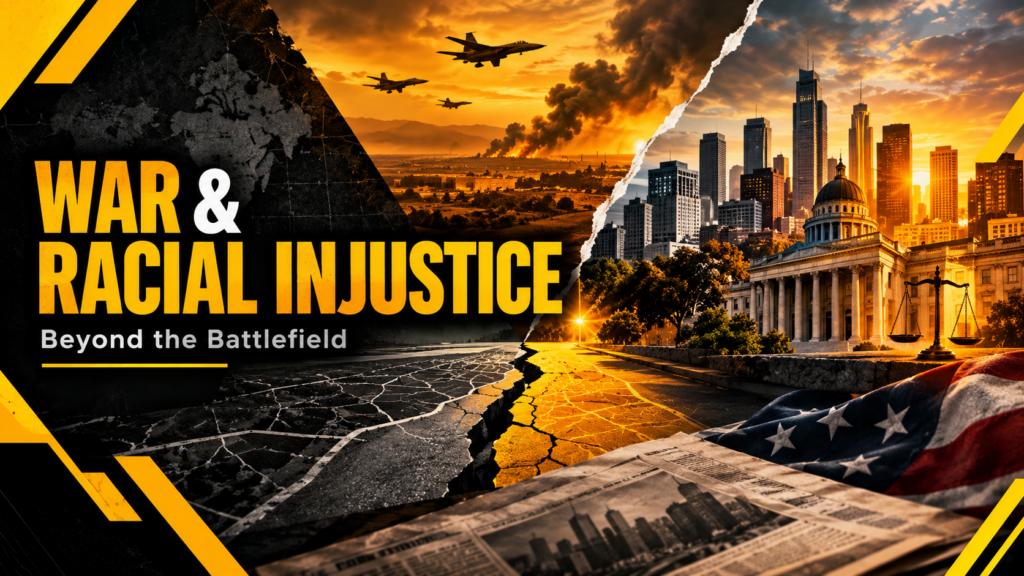
A country can fight a war overseas while fighting over equality at home.
That tension has appeared throughout history.
A government may describe a war as a defense of freedom, democracy, or national security. At the same time, people within that same country may question whether those ideals are being applied equally to everyone.
For Black communities and other communities facing discrimination, that contradiction can become impossible to ignore.
A soldier may be asked to fight for freedom abroad while their family continues facing discrimination at home. A community may be asked to unite behind a national cause while still dealing with unequal treatment, mistrust, or exclusion.
This is why war and racial injustice are not separate subjects.
Conflict can expose existing divisions, intensify them, or sometimes create new political pressure for change. The relationship is complicated, and it rarely moves in only one direction.
Understanding that history means looking beyond the battlefield and asking a harder question:
What happens when a society fighting an external enemy is still struggling with injustice within its own borders?
Key Takeaways
- War can expose contradictions between national ideals and unequal treatment at home.
- Military conflict can intensify existing racial divisions, but it can also create pressure for social and political change.
- Black communities have often connected military service, citizenship, civil rights, and racial equality in powerful ways.
- The consequences of war beyond the battlefield can continue through communities, institutions, memory, and future generations.
Why Are War and Racial Injustice Connected?
War changes societies.
People move.
Industries expand or collapse.
Governments introduce new policies.
Military service creates new expectations about citizenship.
Communities experience fear, economic pressure, and uncertainty.
All of these changes can interact with existing racial inequalities.
Historian Thomas Sugrue’s research on the Black freedom struggle in the United States shows that racial discrimination was not limited to the South. African Americans also faced segregation, discrimination in employment and housing, unequal schools, and discriminatory policing in northern cities. His work also shows how major periods of national upheaval, including World War I, World War II, and their aftermaths, interacted with racial conflict and civil-rights activism.
That history matters because war does not enter a society that starts from zero.
It enters an existing social structure.
If racial inequality already exists, war can put additional pressure on those inequalities.
Sometimes the result is greater division.
Sometimes the result is greater resistance.
And sometimes it is both at once.
How Can War and Racism Reinforce Each Other?
One of the clearest patterns appears when national fear combines with existing racial stereotypes.
During periods of war or heightened security concerns, governments and communities may become more focused on identifying threats.
That can create an environment where racial, ethnic, religious, or national identities become unfairly associated with danger.
This does not mean every wartime society automatically becomes more racist.
It means that periods of fear can make existing prejudices more powerful.
The social pressure can work in several directions.
A minority community may face increased suspicion.
People may feel pressured to prove their loyalty.
Political disagreement may become harder to express.
Patriotism may be used as a test of belonging.
And communities that already feel excluded may become even more distrustful of institutions.
These dynamics show how race and social conflict can overlap during periods of national crisis.
The problem is not only what happens during the conflict itself.
It is what those attitudes can leave behind.
What Happened to Black Communities During Wartime America?
American history provides several examples of this contradiction.
During World War II, Black Americans faced segregation and discrimination while the United States presented the war as a global struggle against fascism and dictatorship.
That contradiction helped energize demands for greater equality.
The National Geographic historical account of the period describes how civil-rights and labor leaders connected the fight against fascism abroad with the struggle against racism at home. A. Philip Randolph pressured the federal government over discrimination in defense employment, while the Pittsburgh Courier’s “Double V” campaign called for victory against fascism overseas and against racism at home.
The idea was powerful because it exposed a basic contradiction.
If democracy was worth defending abroad, why should it be denied to people at home?
The question helped reshape political discussion.
Yet wartime pressure did not simply produce progress.
Racial conflict also intensified in several American cities during the period. Historians have documented violence, discrimination, police tensions, and disputes over housing and employment as Black migration into northern and western cities changed local populations.
That is why the relationship between war and racial equality cannot be described as a simple story of improvement.
War can open doors.
It can also expose how many doors remain closed.
How Did Military Service Complicate Racial Equality?
Military service has often created a difficult question for minority communities:
If a country expects your service, what does it owe you in return?
For Black Americans, that question has a long history.
Serving in the military could represent patriotism, opportunity, dignity, and citizenship.
But service did not automatically guarantee equality.
That gap could be deeply frustrating.
A person could risk their life for a national cause and return to a society where housing, employment, education, voting, or policing remained unequal.
This contradiction helped fuel debates about citizenship and racial justice.
The historical relationship between World War II and civil rights is complex. Scholars have shown that the wartime period created opportunities for political organizing and challenged racial systems, but it did not push the United States toward equality in one simple or inevitable direction.
That nuance matters.
War can create conditions for change without guaranteeing what kind of change will follow.
Why Can War Increase Racial Tensions at Home?
There are several reasons.
Economic competition
War can reshape labor markets quickly.
New factories open.
Workers move.
Housing becomes scarce.
Communities change.
When groups compete for jobs or housing, existing racial tensions can become more visible.
Population movement
Migration can transform neighborhoods.
The Great Migration brought millions of African Americans out of the South and into northern and western communities. Sugrue’s research documents how this demographic change contributed to intense racial conflict in some cities, including violence over housing and neighborhood boundaries.
Fear and rumor
Periods of crisis create fertile ground for misinformation.
When communities are already divided, rumors can move quickly and deepen mistrust.
Policing and security
During periods of unrest, governments may respond with increased policing or security measures.
If communities already distrust law enforcement, aggressive responses can deepen those divisions.
Political pressure
Governments often emphasize unity during wartime.
But demands for unity can become difficult when minority communities are asking whether the country is living up to its own principles.
That tension helps explain why racial inequality and conflict often appear together in historical research.
Can War Also Create Pressure for Civil Rights?
Yes.
This is one of the most important parts of the story.
Conflict can create contradictions that become politically difficult to ignore.
When a nation asks people to defend democracy, those people may begin asking what democracy means at home.
When industries need workers, discrimination in employment can become harder to justify.
When minority soldiers return from military service, expectations around citizenship and equal treatment may change.
When Black communities organize around wartime injustice, their activism can become part of larger civil-rights movements.
The connection between war and civil rights is therefore not simply destructive.
Sometimes war creates political openings.
But those openings are shaped by activism.
Progress does not happen automatically because a country is at war.
People have to organize, protest, vote, write, litigate, negotiate, and demand change.
That distinction is essential.
What Is the War Impact on Black Communities Today?
The historical question continues to matter because war does not affect every community in exactly the same way.
Black communities may experience national-security policies, military recruitment, veterans’ issues, economic disruption, policing debates, and political conflict through their own social history.
The key issue is context.
A policy that appears neutral on paper can have different consequences across communities because people do not begin from identical social positions.
That is why the war impact on Black communities cannot be understood only by studying military operations.
It requires looking at employment, housing, policing, political participation, family structures, community institutions, and public perceptions of race.
History also shows that Black communities have rarely been passive observers.
From wartime labor campaigns to civil-rights organizing, people have repeatedly challenged the contradiction between national ideals and racial inequality.
What Happens When Racial Inequality Becomes Part of a War Story?
It changes how people remember the conflict.
One person may remember sacrifice.
Another may remember discrimination.
One family may remember a relative’s military service with enormous pride.
Another may remember how that same period affected housing, employment, or community safety.
A society can therefore have multiple memories of the same war.
That is not necessarily a weakness.
It can be a more honest representation of history.
The problem begins when only one version of the story is allowed to survive.
If a nation remembers only military victories, it may miss the social struggles happening alongside them.
If it remembers only injustice, it may overlook the courage and sacrifices made by communities inside the conflict.
A complete historical memory needs room for both.
How Can War Change the Relationship Between Communities?
Imagine a city experiencing a major international crisis.
People from different backgrounds initially come together because everyone feels threatened.
As the crisis continues, old inequalities become harder to ignore.
One neighborhood has fewer resources.
Another community becomes the focus of suspicion.
A group of workers feels excluded from new opportunities.
Young people begin organizing.
A local disagreement becomes a larger argument about race and belonging.
This is a composite scenario, not a specific historical case.
But it illustrates an important pattern.
War can bring people together and divide them at the same time.
It can create shared purpose while exposing unequal experiences of that purpose.
That tension is part of what makes the social consequences of war so difficult to understand.
Why War Does Not Affect Every Community the Same Way
A war is a national event.
Its consequences are not always evenly distributed.
Different communities may have different levels of economic security, political influence, access to resources, and historical trust in institutions.
That means the same national crisis can produce very different experiences.
For one family, wartime economic expansion may create a new opportunity.
For another, housing discrimination may make that opportunity difficult to access.
One community may view military service as a path toward stability.
Another may have complicated feelings about military institutions.
One generation may remember wartime unity.
The next may remember the inequality that existed underneath it.
That is why broad statements about the effects of war can be misleading.
The real story is often local.
What Most People Get Wrong About War and Racial Injustice
Myth: War automatically brings people together.
Reality: War can create solidarity, but it can also expose or intensify existing racial divisions.
Myth: Military service automatically produces racial equality.
Reality: Service can strengthen claims to citizenship and equal treatment, but participation alone does not eliminate discrimination. Historical evidence shows that wartime service and racial inequality have often existed side by side.
Myth: Racial conflict during wartime is only about personal prejudice.
Reality: Economic conditions, housing, employment, policing, political institutions, and population movement can all contribute to racial conflict.
Myth: War always pushes civil rights backward.
Reality: War can create new pressures for equality, even while causing or intensifying racial conflict.
Myth: The battlefield is separate from society.
Reality: Military events can affect families, neighborhoods, labor markets, political debates, and community relationships far from where combat occurs.
A Five-Part Framework for Understanding War and Racial Injustice
To understand war and racial injustice, it helps to look at five connected areas.
1. Power
Who makes decisions during the conflict, and who has influence over those decisions?
2. Opportunity
Who gains access to jobs, housing, education, and economic opportunities created or changed by wartime conditions?
3. Security
Who is treated as protected, and who is treated as suspicious?
4. Citizenship
Who is asked to serve the nation, and what rights or recognition are expected in return?
5. Memory
Whose experiences become part of the national story after the conflict ends?
This framework helps move the conversation beyond a simple question of whether war makes society better or worse.
Sometimes it does both.
How Does War Shape the Next Generation?
The effects of conflict do not always stop with the people who experienced it directly.
Children may inherit family stories.
They may grow up with particular ideas about patriotism.
They may hear stories about discrimination, military service, displacement, sacrifice, or protest.
They may inherit pride.
They may inherit anger.
They may inherit questions.
And eventually, they may decide what to do with those stories.
This is where the connection between war and racial injustice becomes generational.
The next generation may look at an old conflict and ask questions their parents never asked.
Why did this happen?
Who benefited?
Who was excluded?
Why did some communities remember the war differently?
What did citizenship actually mean?
Those questions can influence how history is remembered and how future conflicts are understood.
The Longest War: When Conflict Follows People Home
This human dimension is particularly relevant to Diaries From The Forsaken: Entry II: The Longest War.
The published description centers on Julius Fernandez, a man who lived through the Global War on Terrorism. It presents his experience as one connected not only to overseas conflict but also to distance from family, grief, social tensions, and questions of race and justice at home.
That perspective fits naturally into this discussion because it asks readers to look at conflict from more than one direction.
What happens overseas?
What happens when someone comes home?
What happens to the family?
What happens to identity?
And what happens when racial and social conflict becomes part of the same story?
Those questions make war literature valuable in a way that a timeline sometimes cannot.
A timeline tells readers what happened.
A character lets them consider what those events might mean to a person living through them.
Why Stories About War and Racial Injustice Matter
Historical research can explain patterns.
Personal stories can make those patterns feel immediate.
A book can place a reader inside a character’s uncertainty.
It can show how race affects an individual’s understanding of military service.
It can explore what happens when patriotism collides with injustice.
It can show how a person’s relationship with home changes after experiencing conflict elsewhere.
And it can ask questions without pretending that history has simple answers.
That is especially important with subjects such as war and racism.
The danger of oversimplification is high.
War can expose racism.
War can intensify racism.
War can produce solidarity against racism.
War can create pressure for civil-rights reform.
Sometimes all of these things happen at once.
The best stories leave room for that complexity.
Explore Stories That Look Beyond the Battlefield
Readers interested in the connection between conflict, race, identity, and social change can explore the author’s books for a more personal and literary perspective on these themes.
The Longest War is particularly relevant to readers interested in how overseas conflict can intersect with questions of family, race, justice, and life at home. The published description of Julius Fernandez presents a character caught between wars while dealing with the human consequences that continue beyond military service.
Readers who want to experience the author’s stories in sequence can follow the reading order.
Those who want more context about the writer and the perspective behind the stories can visit the author’s about page.
For readers who enjoy exploring the ideas behind the books themselves, the author’s blogs provide another way to continue the conversation around war, society, history, and the people shaped by them.
The value of these stories is not that they provide an easy answer to racial injustice.
It is that they make readers sit with the harder questions.
What does loyalty mean when a society is unequal?
What does justice look like after conflict?
Can someone love a country while criticizing its failures?
And what does a generation inherit from wars it did not choose?
Those questions are often where the most meaningful war stories begin.
Final Thoughts
The relationship between war and racial injustice is uncomfortable precisely because it reveals contradictions.
A nation can fight for freedom abroad while people at home are still fighting for equal treatment.
A community can experience wartime unity while facing discrimination within that same society.
A soldier can serve a country while questioning whether that country fully recognizes people like them.
And a generation can inherit both the pride and the unresolved questions of the one before it.
History shows that war can deepen racial divisions.
It can also expose those divisions so clearly that people can no longer ignore them.
That is the complicated relationship between conflict and social change.
The important lesson is not that war automatically causes racism or automatically produces progress.
It is that war places pressure on existing systems.
It changes economies.
It moves people.
It reshapes political conversations.
It tests ideas about citizenship.
And sometimes, it forces a society to confront the distance between what it claims to believe and how people actually experience those beliefs.
James Baldwin put the responsibility of confronting difficult realities plainly: “Not everything that is faced can be changed; but nothing can be changed until it is faced.”
That idea reaches beyond any one conflict.
Understanding racial injustice after war requires facing the full story, including the uncomfortable parts.
It means remembering the soldiers and the civilians.
The sacrifices and the inequalities.
The moments of unity and the moments of division.
The victories and the unfinished work.
That is also why literary perspectives on war remain valuable.
A historical record can tell us what happened.
A personal story can ask what it meant.
Because the battlefield may be where a war is fought.
But society is where its consequences are lived.
And sometimes, the most important conflict is the one people are still trying to understand after the fighting has stopped.
FAQs
What is the connection between war and racial injustice?
War can interact with existing racial inequalities through economic pressure, migration, military service, policing, political debates, and social tensions.
How does war and racism affect communities?
Conflict can intensify suspicion, competition, discrimination, and mistrust, while also creating new opportunities for communities to organize and demand equality.
Can war lead to racial inequality?
War itself does not automatically create racial inequality, but wartime policies, economic disruption, population movement, and security measures can reinforce existing inequalities.
How can war affect Black communities?
Black communities can experience wartime change through employment, migration, military service, housing, policing, political organizing, and broader debates about citizenship and equality.
What is racial injustice after war?
It refers to racial inequalities, discrimination, social divisions, and unresolved community tensions that remain or develop after a conflict.
How are race and social conflict connected?
Racial inequality can shape access to housing, employment, political influence, and public institutions, which can become especially visible during periods of crisis or rapid social change.
Can war influence civil rights?
Yes. Wartime contradictions and social changes can create political pressure for civil-rights reforms, although conflict can also produce repression and deeper divisions.
Why is war beyond the battlefield important?
The consequences of war can reach families, workplaces, neighborhoods, political institutions, and future generations far from the fighting itself.
Can war change how people understand citizenship?
Yes. Military service, sacrifice, national loyalty, and unequal treatment can lead communities to question what citizenship should mean and whether rights are being applied equally.
Why do books about war and racial injustice matter?
Stories can explore the personal side of conflicts by showing how race, family, military service, identity, and social divisions affect individual lives.